Appetite for history | The Hindu
Thursday, 30 May 2013


Monday, 6 May 2013
Seema Chisti in Indian Express on Ghadar party centenary
http://www.indianexpress.com/news/from-us-the-effort-to-free-india-from-british/1105706/
P Chidambaram's bud-get speech had at least one entry whose significance could go beyond accounts. The Centre has decided to mark 100 years of the formation of the Ghadar Party this year and allocated funds to build and maintain its museum in San Francisco, apart from organising a series of programmes at home.The Ghadar Party's first office-bearers were chosen in Astoria on April 21, 1913 — the year before World War I, with British imperialism at its peak, and before the Soviet Union had been formed. A group of angry anarchists and socialists, some of them university students, some peasant-farmers and all based abroad, decided that the root cause of oppression of their fellow Indians was imperialism and they would fight it.
Inspired by 'Ghadar' of 1857, Karl Marx, and the spirit they then saw in the US for providing immigrants freedom and a platform to fight for what they felt was right, they ended up setting up the party in the University of Berkeley, California, and egged on thousands of immigrant workers to sail back to India and help "liberate" it. Pioneer leaders Lala Hardyal, Tarak Nath Das, Baba Sohan Singh Bhakna and Maulvi Barakatullah openly said their plan was actually to fight the British. And they arrived in India from California to do just that.
Historians and scholars working on the Ghadar Party are heartened by the government effort, saying the unique movement will finally be given its place in history. Historian Harish K Puri, based in Ludhiana, says it is an important strain in India's nationalist legacy and must not be airbrushed only because it does not fit into the Gandhian Congress story.
"The fact that people who had gone out to earn their living through manual labour were able to identify the root problem of their hardships here, and make a connection with unfair attitudes to immigrants with colonialism, was a huge leap of ideas," Puri says. "Bhagat Singh, Chittagong, Netaji's INA, and the Naval Revolt of 1946 all owed a lot to the Ghadar Party idea and broke the back of the British in India."
Puri, who met Bhakna when the latter was 96, was "mesmerised by his spirit, Catholicism, broad vision and ability to conceive of a movement which believed in bringing Punjabi Sikhs, Hindus, Muslims, Marathis, Gujaratis all together, at a time when revivalist movements were on in almost all faiths. These people in divisive times developed the idea of 'desh'."
Puri recounts how the anarchists' ideas influenced the times. Tarak Nath in 1908 wrote to Leo Tolstoy about War and Peace, asking Tolstoy, complete with 10-year data on deaths due to hunger and famine in India, how this was any better than the war-related deaths Tolstoy was so eloquent about. "Tolstoy replied, and even Gandhi took note of that reply. This was the impact of those people."
Says Prof Chaman Lal of Jawaharlal Nehru University, who has travelled to most places connected with Ghadar and kept records, "What worries me is that either no one wants to talk about it as it does not fit into a goody-goody non-violence narrative we want to put out, or the wrong people try and appropriate it. Now, radical Sikh extremists try and portray them as Sikh radicals — while they were pious, they were the antithesis of identity games outside of 'desh'. Their message was the opposite."
Says Savitri Sawhney, the daughter of one of the Marathi revolutionaries of the time, Dr Pandurang Khankhoje, "At the Pravasi Bhartiya meet this year, two descendants of the Ghadar movement were to be honoured, but it was all changed at the last minute. The establishment suddenly didn't want to honour anybody outside the Gandhi-Nehru fold; they are still regarded as terrorists. This is wrong. They must find a place in popular memory."
Congress party representatives deny any deliberate effort to ignore the movement. If that was the case, they say, the PM would not otherwise have called it a "luminous spark" guiding the independence struggle at the Pravasi Divas at Kochi, "nor would he have released a commemorative stamp".
Says Prof Chaman Lal, "The Ghadar strain was left without takers after independence except communist parties, who see themselves in part as bearers of the ideas."
The US-Canada based Left-affiliated Indian Workers Association and its UK counterpart, the Indian Workers Association, are organising a series of meetings, seminars, rallies and plays by an Indian troupe over the next year to remind people of Ghadar, and of the fact that even Indian NRIs today owe much of the awareness and freedom to those who founded the party to fight the case for immigrant Asians, mostly Asian workers working in the West then.
A museum was set up in Jalandhar in 1955, principally by Ghadar revolutionaries released from the Andaman islands after serving life sentences.
Ghadar revolutionaries exercised a deep influence on those who came a decade later. Says Bhagat Singh's nephew Kiranjit Singh, "Ghadar hero Kartar Singh Sarabha was his hero and he carried a picture of his in his pocket at all times. Sarabha was executed when he was 19, and embedded in my uncle the philosophy of meeting your death with a smile, which he did." Says Prof Puri, "Bhagat Singh pored over the famous Ghadar Party trial case records in Lahore and we have his copy in the museum, with his notes scribbled in the margins."
- See more at: http://www.indianexpress.com/news/from-us-the-effort-to-free-india-from-british/1105706/0#sthash.GOhSrrif.dpuf
Inspired by 'Ghadar' of 1857, Karl Marx, and the spirit they then saw in the US for providing immigrants freedom and a platform to fight for what they felt was right, they ended up setting up the party in the University of Berkeley, California, and egged on thousands of immigrant workers to sail back to India and help "liberate" it. Pioneer leaders Lala Hardyal, Tarak Nath Das, Baba Sohan Singh Bhakna and Maulvi Barakatullah openly said their plan was actually to fight the British. And they arrived in India from California to do just that.
Historians and scholars working on the Ghadar Party are heartened by the government effort, saying the unique movement will finally be given its place in history. Historian Harish K Puri, based in Ludhiana, says it is an important strain in India's nationalist legacy and must not be airbrushed only because it does not fit into the Gandhian Congress story.
"The fact that people who had gone out to earn their living through manual labour were able to identify the root problem of their hardships here, and make a connection with unfair attitudes to immigrants with colonialism, was a huge leap of ideas," Puri says. "Bhagat Singh, Chittagong, Netaji's INA, and the Naval Revolt of 1946 all owed a lot to the Ghadar Party idea and broke the back of the British in India."
Puri, who met Bhakna when the latter was 96, was "mesmerised by his spirit, Catholicism, broad vision and ability to conceive of a movement which believed in bringing Punjabi Sikhs, Hindus, Muslims, Marathis, Gujaratis all together, at a time when revivalist movements were on in almost all faiths. These people in divisive times developed the idea of 'desh'."
Puri recounts how the anarchists' ideas influenced the times. Tarak Nath in 1908 wrote to Leo Tolstoy about War and Peace, asking Tolstoy, complete with 10-year data on deaths due to hunger and famine in India, how this was any better than the war-related deaths Tolstoy was so eloquent about. "Tolstoy replied, and even Gandhi took note of that reply. This was the impact of those people."
Says Prof Chaman Lal of Jawaharlal Nehru University, who has travelled to most places connected with Ghadar and kept records, "What worries me is that either no one wants to talk about it as it does not fit into a goody-goody non-violence narrative we want to put out, or the wrong people try and appropriate it. Now, radical Sikh extremists try and portray them as Sikh radicals — while they were pious, they were the antithesis of identity games outside of 'desh'. Their message was the opposite."
Says Savitri Sawhney, the daughter of one of the Marathi revolutionaries of the time, Dr Pandurang Khankhoje, "At the Pravasi Bhartiya meet this year, two descendants of the Ghadar movement were to be honoured, but it was all changed at the last minute. The establishment suddenly didn't want to honour anybody outside the Gandhi-Nehru fold; they are still regarded as terrorists. This is wrong. They must find a place in popular memory."
Congress party representatives deny any deliberate effort to ignore the movement. If that was the case, they say, the PM would not otherwise have called it a "luminous spark" guiding the independence struggle at the Pravasi Divas at Kochi, "nor would he have released a commemorative stamp".
Says Prof Chaman Lal, "The Ghadar strain was left without takers after independence except communist parties, who see themselves in part as bearers of the ideas."
The US-Canada based Left-affiliated Indian Workers Association and its UK counterpart, the Indian Workers Association, are organising a series of meetings, seminars, rallies and plays by an Indian troupe over the next year to remind people of Ghadar, and of the fact that even Indian NRIs today owe much of the awareness and freedom to those who founded the party to fight the case for immigrant Asians, mostly Asian workers working in the West then.
A museum was set up in Jalandhar in 1955, principally by Ghadar revolutionaries released from the Andaman islands after serving life sentences.
Ghadar revolutionaries exercised a deep influence on those who came a decade later. Says Bhagat Singh's nephew Kiranjit Singh, "Ghadar hero Kartar Singh Sarabha was his hero and he carried a picture of his in his pocket at all times. Sarabha was executed when he was 19, and embedded in my uncle the philosophy of meeting your death with a smile, which he did." Says Prof Puri, "Bhagat Singh pored over the famous Ghadar Party trial case records in Lahore and we have his copy in the museum, with his notes scribbled in the margins."
- See more at: http://www.indianexpress.com/news/from-us-the-effort-to-free-india-from-british/1105706/0#sthash.GOhSrrif.dpuf


Monday, 29 April 2013
Release of Understanding Bhagat Singh on 3rd May

To mark May Day, Karl Marx Birthday (5 May) and Ghadar Party Centenary (2013)
AAKAR BOOKS, DELHI
Cordially invite you to a book release and discussion on
UNDERSTANDING BHAGAT SINGH
By
Prof Chaman Lal
To be released by
Professor Randhir Singh, Eminent Thinker
at 3.30 pm on Friday, 3 May 2013
SCHOOL OF SOCIAL SCIENCES (SSS- I) AUDITORIUM, JNU, NEW DELHI
CHAIR Prof G K Chadha, President (Vice Chancellor), South Asian University(SAU), New Delhi
GUEST OF HONOUR Prof S K Sopory, Vice Chancellor, JNU
SPEAKERS Prof Mushirul Hasan, Eminent Historian
Prof Manoranjan Mohanty, Eminent Political Scientist
MODERATOR
REVOLUTIONARY SONGS Nishant Natya Manch
Sunday, 21 April 2013
Don't misuse the blog by your anonymous comments
Everyday 5-10 persons keeping anonymity keep on posting innocuous looking appreciable comments, but with the smartness of giving link of their websites, which are either pornographic or business/commercial oriented. Everyday I reject these comments and delete them, yet there is no stoppage to these. Let every viewer of this blog be clear that no anonymous comments will be accepted on this blog. Viewers commenting on this blog must mention their names and identity in complete, otherwise their comments will be trashed. Commercial/business/porno sites anonymous commentators don't waste your time on this blog, you will never succeed in polluting this blog by your nefarious efforts!
Thursday, 18 April 2013
Navtej Sarna on Bhagat Singh in The Hindu

The Hindu Photo LibraryBhagat Singh: Committed to his cause.
Bhagat Singh was a fearless patriot and an intellectual giant in the making when the gallows took him.
I was a young child in the early 1960s watching the sunny afternoon street that ran past theamaltas tree in front of the house when I was told that it was March 23, the anniversary of the hanging of Bhagat Singh. I did not quite know what a hanging meant but I still remember the nameless and haunting dread that suddenly took over that careless afternoon. A second childhood memory recalls a 1965 front page photograph of the garlanded body of Batukeshwar Dutt, one of Bhagat Singh’s closest associates, under a banner headline: “Batukeshwar Dutt Dead”. I had the impression that he had lived into hoary old age after being awarded life imprisonment. I now realise he was only in his mid-fifties when he died. All this was before the legend of the hanging of Bhagat Singh, Rajguru and Sukhdev was emblazoned emphatically in public consciousness by Manoj Kumar’s superb Shaheed, a film which should be made compulsory watching for every Indian school student.
This year, the first two major newspapers I scanned on March 23 only mentioned Bhagat Singh by way of two government-sponsored advertisements and quite another Dutt dominated the news columns. Mercifully the third newspaper — the one in Punjabi being read by my driver — rescued me from the precipitous edge of cynicism: it carried a front page essay on the revolutionary.
Not only was Bhagat Singh a fearless patriot and one of the most charismatic figures of India’s freedom struggle, he was also a thinker and an intellectual giant in the making when the gallows took him at the young age of 23. Immersed in books from the Dwarka Das Library founded by Lala Lajpat Rai since his childhood, he had given a strong intellectual underpinning and political philosophy, strongly influenced by Marxist-Socialism, to his actions. His wide reading, his grasp of political ideologies and revolutionary movements sweeping the word and his vision of true revolution in India come through in the statements he made at his trials, his letters and his articles. It is believed that during the two years in jail before his hanging he wrote four books, but these are lost. Thankfully, Bhagat Singh’s selected speeches and writings have been edited by Prof. D.N.Gupta and brought out in a slim volume by the National Book Trust and reading them is one way of paying homage to his courage and conviction.
The most substantive piece in the collection is his essay ‘Why am I an Atheist’. This essay was smuggled out of jail and published by Bhagat Singh’s father after his martyrdom in The People, the magazine founded by Lala Lajpat Rai. Bhagat Singh put down his ideas on God and religion on paper when asked by an old prisoner if believed in God. When he replied in the negative, the old man taunted him that he would start believing when his end was near. Bhagat Singh argues against the insinuation that his atheism is an offshoot of any vanity that may attach to him because of the popularity of the trials; rather, he ascribes his conviction that there is no Supreme Being guiding the affairs of men to his deep study of the Marxist doctrine. As he writes: “My previous faith and convictions underwent a remarkable modification. The romance of the violent methods alone which was so prominent amongst our predecessors was replaced by serious ideas. No more mysticism, no more blind faith. Realism became our cult.”
He stuck to his atheism in the most difficult circumstances even though he knew that “belief softens hardships, even can make them pleasant.” He ascribes the invention of God to “encourage man to face boldly all the trying circumstances, to meet all dangers manfully and to check and restrain his outbursts in prosperity and affluence.” He points to the myriad horrors of social and political exploitation to question the existence of a benevolent God and asks why such a Being would create a world of “woes and miseries, a veritable, eternal combination of numberless tragedies.” His cold rational courage has the feel of steel: “I know the moment the rope is fitted round my neck and rafters removed from under my feet. That will be the final moment — that will be the last moment. I, or to be more precise, my soul, as interpreted in the metaphysical terminology, shall all be finished there. Nothing further. A short life of struggle with no such magnificent end shall in itself be the reward if I have the courage to take it in that light. That is all. With no selfish motive or desire to be awarded here or hereafter, quite disinterestedly have I devoted my life to the cause of independence, because I could not do otherwise.”
Similar clear-headed logic and conviction is evident in his statements before the Courts and his letters. He left his home when his father arranged his marriage without his consent and wrote: “My life has already been committed to a noble cause — the cause of freedom of India. For that reason comforts and worldly desires have no attraction in my life.” He was 16. In another amazing letter to the Punjab Governor, he (along with Sukhdev and Rajguru) argues that since they have been accused of waging war against the King and detained as war prisoners they “claim to be shot dead instead of to be hanged....we request and hope that you will very kindly order the military department to send its detachment to perform our execution.” He wrote to Sukhdev who was contemplating suicide over life imprisonment that such a step would be cowardice. As for himself he awaited capital punishment, of which he was always certain, as a “beautiful death” saying that “when the fate of a country is being decided, the fate of individuals should be forgotten.”
But that is not the same as saying that a country, once its tryst with destiny is done, should ever forget such individuals.
E-mail: navtej.sarna@gmail.comhttp://www.thehindu.com/books/books-columns/second-thoughts-cold-courage-of-a-godless-revolutionary/article4584486.ece

Wednesday, 16 January 2013

Sunday, 2 December 2012

Sunday, 11 November 2012
Review of Bhagat Singh de Syasi Dastavez in Punjabi Tribune-11-11-2012
ਭਗਤ ਸਿੰਘ ਦੇ ਸਿਆਸੀ ਦਸਤਾਵੇਜ਼
Posted On November - 10 - 2012
ਸੰਪਾਦਕ: ਪ੍ਰੋ. ਚਮਨ ਲਾਲ
ਅਨੁਵਾਦਕ: ਡਾ. ਜਸਵਿੰਦਰ ਕੌਰ
ਪੰਨੇ: 215, ਮੁੱਲ: 110 ਰੁਪਏ
ਪ੍ਰਕਾਸ਼ਕ: ਨੈਸ਼ਨਲ ਬੁੱਕ ਟਰੱਸਟ, ਇੰਡੀਆ (ਨਵੀਂ ਦਿੱਲੀ)
ਅਨੁਵਾਦਕ: ਡਾ. ਜਸਵਿੰਦਰ ਕੌਰ
ਪੰਨੇ: 215, ਮੁੱਲ: 110 ਰੁਪਏ
ਪ੍ਰਕਾਸ਼ਕ: ਨੈਸ਼ਨਲ ਬੁੱਕ ਟਰੱਸਟ, ਇੰਡੀਆ (ਨਵੀਂ ਦਿੱਲੀ)
ਇਸ ਪੁਸਤਕ ਦੇ ਆਰੰਭ ’ਚ ਲਗਪਗ 12 ਸਫ਼ਿਆਂ ਵਿਚ ਫੈਲੇ ਪੁਸਤਕ ਦੇ ਸੰਪਾਦਕ ਪ੍ਰੋ. ਚਮਨ ਲਾਲ ਦੇ ਵਿਚਾਰ ਸ਼ਹੀਦ ਭਗਤ ਸਿੰਘ ਨੂੰ ਇਕ ਪਰਪੱਕ ਸਿਆਸੀ ਚਿੰਤਕ ਦਰਸਾਉਂਦੇ ਹਨ। ਆਰੰਭਕ ਸਤਰਾਂ ਹੀ ਬੜੀ ਟੁੰਬਵੀਂ ਦਰਦਨਾਕ ਵਿਥਿਆ ਦਾ ਵਿਖਿਆਨ ਕਰਦੀਆਂ ਹਨ ਜਿਹਾ ਕਿ:-
…‘‘23 ਮਾਰਚ 1931 ਨੂੰ ਜਦੋਂ 23 ਵਰ੍ਹੇ ਅਤੇ ਕਰੀਬ 6 ਮਹੀਨਿਆਂ ਦੀ ਉਮਰ ਦੇ ਨੌਜਵਾਨ ਭਗਤ ਸਿੰਘ ਨੂੰ ਉਨ੍ਹਾਂ ਦੇ ਹੀ ਹਮ ਉਮਰ ਸੁਖਦੇਵ ਸਿੰਘ ਅਤੇ ਕਰੀਬ ਇਕ ਸਾਲ ਛੋਟੇ ਰਾਜਗੁਰੂ ਨਾਲ ਲਾਹੌਰ ਜੇਲ੍ਹ ਵਿਚ ਫਾਂਸੀ ਦਿੱਤੀ ਗਈ ਸੀ ਤਾਂ ਉਸ ਤੋਂ ਕੁਝ ਘੰਟੇ ਪਹਿਲਾਂ ਲਾਹੌਰ ਵਿਚ ਹਜ਼ਾਰਾਂ ਲੋਕਾਂ ਦਾ ਜਲਸਾ ਇਨ੍ਹਾਂ ਨੌਜਵਾਨਾਂ ਦੀ ਫਾਂਸੀ ਰੋਕਣ ਦੀ ਮੰਗ ਲਈ ਹੋ ਰਿਹਾ ਸੀ। …ਪਰ ਜਲਸਾ ਖਤਮ ਹੋਣ ਦੇ ਨੇੜੇ ਹੀ ਇਹ ਖ਼ਬਰ ਪਹੁੰਚ ਗਈ ਕਿ ਇਨ੍ਹਾਂ ਨੌਜਵਾਨਾਂ ਨੂੰ ਉਸੇ ਸ਼ਾਮ ਸੱਤ ਵਜੇ ਹੀ ਫਾਂਸੀ ’ਤੇ ਲਟਕਾ ਦਿੱਤਾ ਗਿਆ ਸੀ। ਸੈਂਕੜੇ ਲੋਕ ਇਕੱਠੇ ਜੇਲ੍ਹ ਵੱਲ ਦੌੜ ਪਏ।…ਫਾਂਸੀ ਦੇਣ ਤੋਂ ਬਾਅਦ ਇਨ੍ਹਾਂ ਨੌਜਵਾਨਾਂ ਦੀਆਂ ਹਾਲੀ ਨਿੱਘੀਆਂ ਲਾਸ਼ਾਂ ਨੂੰ ਟੁਕੜੇ-ਟੁਕੜੇ ਕਰਕੇ ਬੋਰਿਆਂ ਵਿਚ ਭਰਿਆ ਗਿਆ ਤੇ ਜੇਲ੍ਹ ਦੇ ਪਿਛਲੇ ਦਰਵਾਜ਼ਿਓਂ ਕੱਢ ਕੇ ਇਕ ਟਰੱਕ ’ਤੇ ਲੱਦ ਕੇ ਫਿਰੋਜ਼ਪੁਰ ਵੱਲ ਲਿਜਾਇਆ ਗਿਆ….।
ਭਗਤ ਸਿੰਘ ਦੇ ਸਿਆਸੀ ਚਿੰਤਨ ਤੇ ਉਸ ਦੇ ਸਿਆਸੀ ਦਸਤਾਵੇਜ਼ਾਂ ਨੂੰ ਦਰਸਾਉਂਦੀ ਇਸ ਪੁਸਤਕ ਦੇ ਸੰਪਾਦਕ ਵੱਲੋਂ ਪੰਜ ਹਿੱਸੇ ਬਣਾਏ ਗਏ ਹਨ। ਪਹਿਲਾ ਹਿੱਸਾ ਕੌਮੀ ਚਿੰਤਨ ਬਾਰੇ ਹੈ, ਤੇ ਦੂਜਾ ਅੰਤਰਾਸ਼ਟਰੀ ਚਿੰਤਨ ਬਾਰੇ ਹੈ। ਤੀਜੇ ਹਿੱਸੇ ਵਿਚ ਇਨਕਲਾਬੀ ਐਕਸ਼ਨ ਦਾ ਦਸਤਾਵੇਜ਼ੀ ਇਜ਼ਹਾਰ ਹੈ। ਚੌਥੇ ਹਿੱਸੇ ਵਿਚ ਜੇਲ੍ਹ ਵਿਚਲੀ ਸਿਆਸੀ ਜੱਦੋ-ਜਹਿਦ ਦੀ ਵਾਰਤਾ ਹੈ। ਇਹ ਹਿੱਸਾ ਪੁਸਤਕ ਦਾ ਸਭ ਤੋਂ ਵੱਡਾ ਹਿੱਸਾ ਹੈ। ਪੰਜਵੇਂ ਹਿੱਸੇ ਵਿਚ ਭਗਤ ਸਿੰਘ ਦੇ ਪਰਪੱਕ ਸਿਆਸੀ ਚਿੰਤਨ ਦਾ ਬਿਰਤਾਂਤ ਹੈ। ਪੁਸਤਕ ਦੀ ਅੰਤਿਕਾ ਵਿਚ ਜਿਨ੍ਹਾਂ ਦੁਰਲੱਭ ਦਸਤਾਵੇਜ਼ਾਂ ਦਾ ਜ਼ਿਕਰ ਕੀਤਾ ਗਿਆ ਹੈ ਉਹ ਇਹ ਹਨ:-
(1) ਸ਼ਹੀਦ ਭਗਤ ਸਿੰਘ ਦੇ ਦੁਰਲੱਭ ਖ਼ਤ
(2) ਭਗਤ ਸਿੰਘ ਦਾ ਪੰਜਾਬੀ ਵਿਚ ਲਿਖਿਆ ਅਪ੍ਰਕਾਸ਼ਿਤ ਖ਼ਤ
(3) ਜੈ ਦੇਵ ਦੇ ਨਾਂ ਭਗਤ ਸਿੰਘ ਦਾ ਅੰਗਰੇਜ਼ੀ ਵਿਚ ਲਿਖਿਆ ਅਪ੍ਰਕਾਸ਼ਿਤ ਖ਼ਤ- 28 ਮਈ 1930
(4) ਜੈ ਦੇਵ ਦੇ ਨਾਂ ਇਕ ਹੋਰ ਖ਼ਤ (ਅੰਗਰੇਜ਼ੀ ਵਿਚ)
(5) ਪੁਲੀਸ ਅਫਸਰ ਦੇ ਨਾਂ ਖ਼ਤ
ਨਿਰਸੰਦੇਹ ਪੂਰੀ ਪੁਸਤਕ ਪੂਰੀ ਗੰਭੀਰਤਾ ਨਾਲ ਪੜ੍ਹਨ ਵਾਲੀ ਹੈ।
-ਹਰਮੀਤ ਸਿੰਘ ਅਟਵਾਲ
* ਮੋਬਾਈਲ: 98155-05287http://punjabitribuneonline.com/2012/11/%E0%A8%AD%E0%A8%97%E0%A8%A4-%E0%A8%B8%E0%A8%BF%E0%A9%B0%E0%A8%98-%E0%A8%A6%E0%A9%87-%E0%A8%B8%E0%A8%BF%E0%A8%86%E0%A8%B8%E0%A9%80-%E0%A8%A6%E0%A8%B8%E0%A8%A4%E0%A8%BE%E0%A8%B5%E0%A9%87%E0%A9%9B/
…‘‘23 ਮਾਰਚ 1931 ਨੂੰ ਜਦੋਂ 23 ਵਰ੍ਹੇ ਅਤੇ ਕਰੀਬ 6 ਮਹੀਨਿਆਂ ਦੀ ਉਮਰ ਦੇ ਨੌਜਵਾਨ ਭਗਤ ਸਿੰਘ ਨੂੰ ਉਨ੍ਹਾਂ ਦੇ ਹੀ ਹਮ ਉਮਰ ਸੁਖਦੇਵ ਸਿੰਘ ਅਤੇ ਕਰੀਬ ਇਕ ਸਾਲ ਛੋਟੇ ਰਾਜਗੁਰੂ ਨਾਲ ਲਾਹੌਰ ਜੇਲ੍ਹ ਵਿਚ ਫਾਂਸੀ ਦਿੱਤੀ ਗਈ ਸੀ ਤਾਂ ਉਸ ਤੋਂ ਕੁਝ ਘੰਟੇ ਪਹਿਲਾਂ ਲਾਹੌਰ ਵਿਚ ਹਜ਼ਾਰਾਂ ਲੋਕਾਂ ਦਾ ਜਲਸਾ ਇਨ੍ਹਾਂ ਨੌਜਵਾਨਾਂ ਦੀ ਫਾਂਸੀ ਰੋਕਣ ਦੀ ਮੰਗ ਲਈ ਹੋ ਰਿਹਾ ਸੀ। …ਪਰ ਜਲਸਾ ਖਤਮ ਹੋਣ ਦੇ ਨੇੜੇ ਹੀ ਇਹ ਖ਼ਬਰ ਪਹੁੰਚ ਗਈ ਕਿ ਇਨ੍ਹਾਂ ਨੌਜਵਾਨਾਂ ਨੂੰ ਉਸੇ ਸ਼ਾਮ ਸੱਤ ਵਜੇ ਹੀ ਫਾਂਸੀ ’ਤੇ ਲਟਕਾ ਦਿੱਤਾ ਗਿਆ ਸੀ। ਸੈਂਕੜੇ ਲੋਕ ਇਕੱਠੇ ਜੇਲ੍ਹ ਵੱਲ ਦੌੜ ਪਏ।…ਫਾਂਸੀ ਦੇਣ ਤੋਂ ਬਾਅਦ ਇਨ੍ਹਾਂ ਨੌਜਵਾਨਾਂ ਦੀਆਂ ਹਾਲੀ ਨਿੱਘੀਆਂ ਲਾਸ਼ਾਂ ਨੂੰ ਟੁਕੜੇ-ਟੁਕੜੇ ਕਰਕੇ ਬੋਰਿਆਂ ਵਿਚ ਭਰਿਆ ਗਿਆ ਤੇ ਜੇਲ੍ਹ ਦੇ ਪਿਛਲੇ ਦਰਵਾਜ਼ਿਓਂ ਕੱਢ ਕੇ ਇਕ ਟਰੱਕ ’ਤੇ ਲੱਦ ਕੇ ਫਿਰੋਜ਼ਪੁਰ ਵੱਲ ਲਿਜਾਇਆ ਗਿਆ….।
ਭਗਤ ਸਿੰਘ ਦੇ ਸਿਆਸੀ ਚਿੰਤਨ ਤੇ ਉਸ ਦੇ ਸਿਆਸੀ ਦਸਤਾਵੇਜ਼ਾਂ ਨੂੰ ਦਰਸਾਉਂਦੀ ਇਸ ਪੁਸਤਕ ਦੇ ਸੰਪਾਦਕ ਵੱਲੋਂ ਪੰਜ ਹਿੱਸੇ ਬਣਾਏ ਗਏ ਹਨ। ਪਹਿਲਾ ਹਿੱਸਾ ਕੌਮੀ ਚਿੰਤਨ ਬਾਰੇ ਹੈ, ਤੇ ਦੂਜਾ ਅੰਤਰਾਸ਼ਟਰੀ ਚਿੰਤਨ ਬਾਰੇ ਹੈ। ਤੀਜੇ ਹਿੱਸੇ ਵਿਚ ਇਨਕਲਾਬੀ ਐਕਸ਼ਨ ਦਾ ਦਸਤਾਵੇਜ਼ੀ ਇਜ਼ਹਾਰ ਹੈ। ਚੌਥੇ ਹਿੱਸੇ ਵਿਚ ਜੇਲ੍ਹ ਵਿਚਲੀ ਸਿਆਸੀ ਜੱਦੋ-ਜਹਿਦ ਦੀ ਵਾਰਤਾ ਹੈ। ਇਹ ਹਿੱਸਾ ਪੁਸਤਕ ਦਾ ਸਭ ਤੋਂ ਵੱਡਾ ਹਿੱਸਾ ਹੈ। ਪੰਜਵੇਂ ਹਿੱਸੇ ਵਿਚ ਭਗਤ ਸਿੰਘ ਦੇ ਪਰਪੱਕ ਸਿਆਸੀ ਚਿੰਤਨ ਦਾ ਬਿਰਤਾਂਤ ਹੈ। ਪੁਸਤਕ ਦੀ ਅੰਤਿਕਾ ਵਿਚ ਜਿਨ੍ਹਾਂ ਦੁਰਲੱਭ ਦਸਤਾਵੇਜ਼ਾਂ ਦਾ ਜ਼ਿਕਰ ਕੀਤਾ ਗਿਆ ਹੈ ਉਹ ਇਹ ਹਨ:-
(1) ਸ਼ਹੀਦ ਭਗਤ ਸਿੰਘ ਦੇ ਦੁਰਲੱਭ ਖ਼ਤ
(2) ਭਗਤ ਸਿੰਘ ਦਾ ਪੰਜਾਬੀ ਵਿਚ ਲਿਖਿਆ ਅਪ੍ਰਕਾਸ਼ਿਤ ਖ਼ਤ
(3) ਜੈ ਦੇਵ ਦੇ ਨਾਂ ਭਗਤ ਸਿੰਘ ਦਾ ਅੰਗਰੇਜ਼ੀ ਵਿਚ ਲਿਖਿਆ ਅਪ੍ਰਕਾਸ਼ਿਤ ਖ਼ਤ- 28 ਮਈ 1930
(4) ਜੈ ਦੇਵ ਦੇ ਨਾਂ ਇਕ ਹੋਰ ਖ਼ਤ (ਅੰਗਰੇਜ਼ੀ ਵਿਚ)
(5) ਪੁਲੀਸ ਅਫਸਰ ਦੇ ਨਾਂ ਖ਼ਤ
ਨਿਰਸੰਦੇਹ ਪੂਰੀ ਪੁਸਤਕ ਪੂਰੀ ਗੰਭੀਰਤਾ ਨਾਲ ਪੜ੍ਹਨ ਵਾਲੀ ਹੈ।
-ਹਰਮੀਤ ਸਿੰਘ ਅਟਵਾਲ
* ਮੋਬਾਈਲ: 98155-05287http://punjabitribuneonline.com/2012/11/%E0%A8%AD%E0%A8%97%E0%A8%A4-%E0%A8%B8%E0%A8%BF%E0%A9%B0%E0%A8%98-%E0%A8%A6%E0%A9%87-%E0%A8%B8%E0%A8%BF%E0%A8%86%E0%A8%B8%E0%A9%80-%E0%A8%A6%E0%A8%B8%E0%A8%A4%E0%A8%BE%E0%A8%B5%E0%A9%87%E0%A9%9B/
Thursday, 8 November 2012

Wednesday, 7 November 2012
Down Bhagat Singh Lane-Frontline
http://www.frontline.in/fl2921/stories/20121102292105300.htm
| ||||
  HISTORY Down Bhagat Singh lane
 Shadman Chowk, now renamed Bhagat Singh Chowk. It was built at the site of the gallows of the historic jail of Lahore where Bhagat Singh (below) and his comrades were hanged. 
ALL major newspapers in India carried the Press Trust of India release from Islamabad on September 30 about Shadman Chowk in Lahore, Pakistan, being officially renamed Bhagat Singh Chowk. The demand for the renaming is not new; many a time in the past, civil society groups put up signboards calling the road junction Bhagat Singh Chowk on March 23, when they would gather with candles to pay homage to the memory of Bhagat Singh, Rajguru and Sukhdev, who were executed on that day in 1931. They, of course, would later be removed by the civic authorities.
Shadman Chowk is at the centre of Shadman Colony. The middle-class colony was built after the Pakistani authorities demolished, in 1961, the historic jail of Lahore, where many freedom fighters, such as Kartar Singh Sarabha and many of his comrades of the Ghadar Party, were executed in 1915. The chowk was built where the gallows had stood.
Old-timers say that until the 1965 war, people from India and Pakistan could freely move to each other’s countries with minimal restrictions. Thus people from India coming to visit Nankana Sahib, the birthplace of Guru Nanak, would invariably travel 40 kilometres from there to visit Chak No.105, Lyallpur Bange, Faisalabad, the house where Bhagat Singh was born.
I visited Bhagat Singh’s house in 2007. On the way to his village, we came across an 82-year-old person named Farhad Khan, a retired government official, who had named the street to his house Bhagat Singh Lane. He insisted on taking us to his house. In his drawing room was an old black-and-white photograph of Bhagat Singh.
At Bhagat Singh’s birthplace, we met the present occupants of the big house, who were all reverence for the martyr. Later, a friend sent me the photograph of the primary school where Bhagat Singh studied. It is now in a dilapidated condition, as reports on Bhagat Singh’s birth anniversary in Lahore say.
Bhagat Singh, Rajguru and Sukhdev were to be executed early in the morning on March 24 as per jail practice. But in a rare aberration in history, the trio was executed around 7 p.m. the previous evening, on secret orders that were issued to the jail officials on March 17. After the execution, the bodies of the three martyrs were taken to Ganda Singhwala village near Kasur, now in India, on the Hussainiwala border in Ferozepur district of Punjab, and half-burnt. The remains were picked up by hundreds of people who had walked from Lahore for more than 50 kilometres following the British police. The police had secretly taken the bodies out through the back gate of the jail fearing a backlash from the people who had gathered in large numbers at the jail gate.

People brought the half-burnt pieces of the bodies of the martyrs and cremated them with great respect, with the whole of Lahore observing a bandh and more than 50,000 people joining the funeral procession. This was reported by The Tribune, published from Lahore in those days, on March 26, 1931.
The Naujawan Bharat Sabha, established by Bhagat Singh and his comrades, decided to build a befitting memorial for the martyrs on the banks of the Ravi, where they were cremated. Donations were collected for this. But the Congress party foiled the plan.
Apparently, the Congress, through Kishan Singh, Bhagat Singh’s father, who was its activist, promised that it would build the memorial. Comrade Ramchand, an office-bearer of the Sabha, has detailed this treachery in his book on the history of the organisation.
Apart from the Lahore jail, there are many other places in Lahore city that are in one way or the other associated with Bhagat Singh and his comrades. Bradlaugh Hall, built in memory of the British socialist Charles Bradlaugh, who was a supporter of the Indian freedom movement, was the headquarters of the Punjab Congress party. It also housed the National College in Lahore, where Bhagat Singh and Sukhdev were students. This heritage site is also in a bad condition now. I could locate it with much difficulty during my 2007 visit.
Lahore is where Bhagat Singh and his associates in the Naujawan Bharat Sabha assassinated J.P. Saunders, the Deputy Superintendent of Police responsible for raining lathi blows on Lala Lajpat Rai on October 30, 1928, when he was leading a protest against the visit of the Simon Commission to the city.

Lala Lajpat Rai died from the blows on November 17, 1928, and Basanti Devi, the widow of the radical nationalist leader C.R. Das, exhorted the Indian youth to avenge the killing of Lajpat Rai. Bhagat Singh and his comrades accepted her call despite their differences with Lajpat Rai on many issues.
Though the decision was to kill the Superintendent of Police James A. Scott, who had ordered the lathi charge, it was Saunders, who had hit Lajpat Rai on the head, who became the victim.
The revolutionaries did not regret the assassination as they treated Saunders not as an individual but as a representative of the oppressive British colonial administration.
Saunders was killed in front of the office of the Senior Superintendent of Police in Lahore. Faiz Ahmad Faiz and Mazhar Ali, father of Tariq Ali, celebrated author and communist leader from Pakistan, who were in the Government College nearby at that time, heard the gunshots. It was in this case that Bhagat Singh, Rajguru and Sukhdev were hanged at the place, now named Bhagat Singh Chowk.
Bhagat Singh has always attracted the attention of Pakistani writers and historians. The eminent Sindhi poet Sheikh Ayaz has written a poetic play on his life; the Punjabi writer Ahmad Salim has many publications on him, including Bhagat Singh: Jivan ate Adarsh (Bhagat Singh: Life and Ideals) and a poetry collection, Kehdi Man ne Bhagat Singh Jammia (Which Mother gave birth to Bhagat Singh); and the Urdu writer Zahida Hina has described Bhagat Singh as the most honoured martyr of Pakistan. Najam Hussain Syed, Faiz’s daughter, and the art historian Salima Hashmi have written about him. The historian Mubarak Ali has written about him in Dawn, a respected daily of Pakistan. Sibte Rizvi has translated Ajoy Ghosh’s book Bhagat Singh and his Comrades into Urdu.
Pakistan’s leftist movement and civil society need liberal icons like Bhagat Singh to counter the jehadi movements. The naming of the road junction, though a small and symbolic gesture, is a significant step in that direction. Interestingly, Bhagat Singh has been projected in Pakistan and its media as a strong anti-imperialist working class representative. Many activists call him Comrade Bhagat Singh and describe him as the Che Guevara of South Asia.
There is a demand to establish a museum at his birthplace. Also, opinion is building in favour of protecting Bradlaugh Hall as a heritage building. British colonialism tried to eliminate all signs of Bhagat Singh in Lahore, but now history has taken a different turn.
There was a proposal to have a Bhagat Singh memorial lecture in the British Parliament during the Bhagat Singh centenary, for which Prof. Bipan Chandra’s name was suggested. That event failed to take place.
Chaman Lal is Professor at the Centre of Indian Languages, Jawaharlal Nehru University, New Delhi, and editor/author of many books on Bhagat Singh, including his complete documents.
|


Tuesday, 16 October 2012
Krantiveer Bhagat Singh-Prabhat Khabar review
http://epaper.prabhatkhabar.com/epapermain.aspx?queryed=9&eddate=09%2f30%2f2012
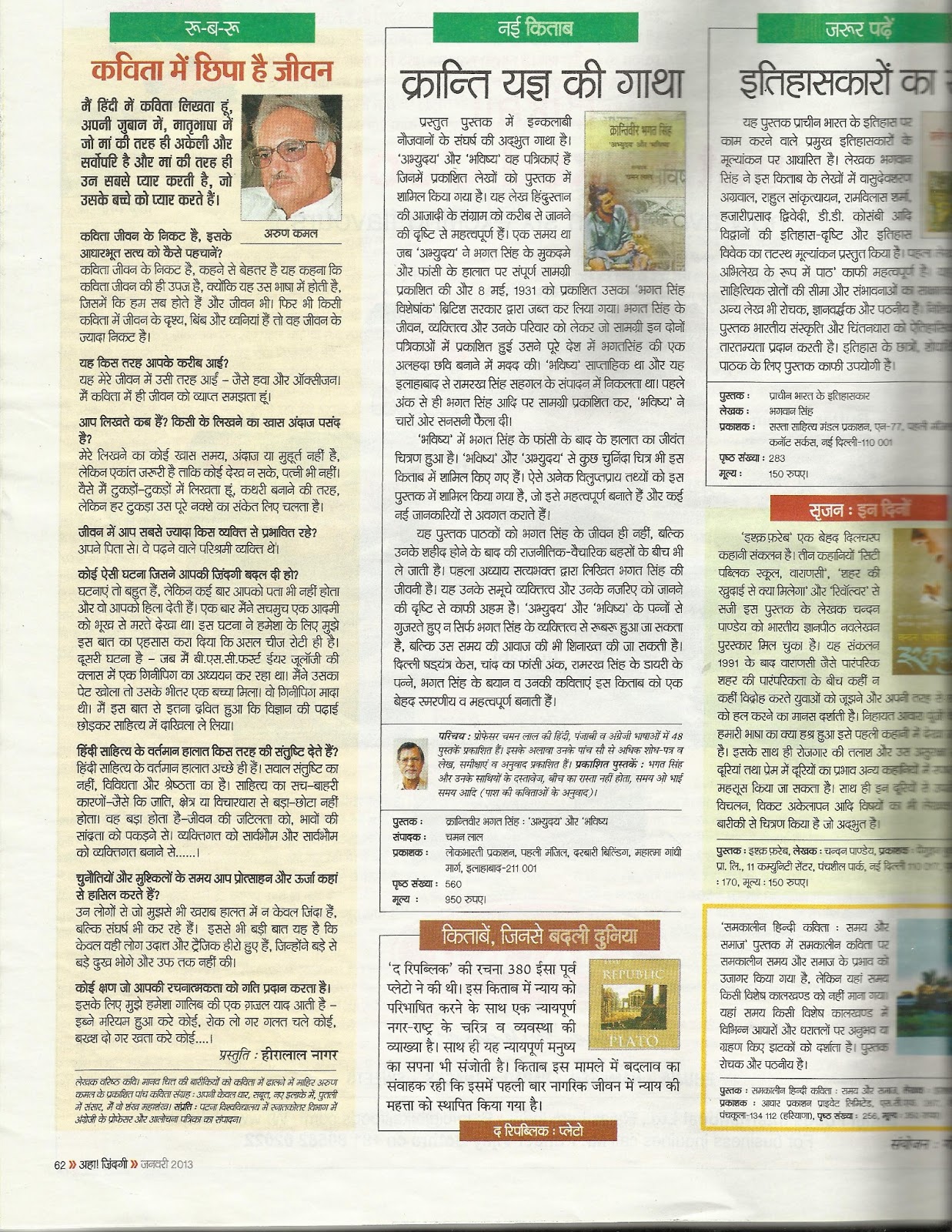
प्रो फेसर चमन लाल को इस बात का श्रेय जाता है कि उन्होंने भगत सिंह की परंपरा को किंवदंती बनने के खतरे से बाहर निकालकर तथ्यात्मक धरातल पर लाने का ऐतिहासिक काम किया है. अपने नायकों के जीवन को किंवदंती में तब्दील कर देना हमें भले प्रभाता हो, लेकिन यह समाज को बहुत लाभ नहीं पहुंचाता. बल्कि इसकी जगह खतरा इस बात का रहता है कि समाज के अलग-अलग समूह नायकों का इस्तेमाल अपने-अपने तरीके से करें. और यह अकसर नुकसानदेह ज्यादा होता है. भगत सिंह के जीवन, उनके विचारों को तथ्यात्मक विेषण की जमीन पर लाने के अपने अथक अभियान में जुटे प्रोफेसर चमन लाल ने अब भगत सिंह से संबंधित कुछ दुर्लभ और अप्राप्य सामग्रियों को क्रांतिवीर ‘भगत सिंह : ‘अभ्युदय’ और ‘भविष्य’’, नाम की किताब में संपादित किया है. यह किताब पाठकों को भगत सिंह के जीवन ही नहीं, उनके शहीद होने के बाद की राजनीतिक-वैचारिक बहसों के बीच भी ले जाती है. चमन लाल लिखते हैं, ‘हम सिर्फ नाम याद रखते हैं, काम नहीं. नामों के साथ जु.डे हुए उनके कामों को हम अकसर भूल जाते हैं..हम उन्हें अपने रंग में रंग देते हैं. भगत सिंह जैसे समाजवादी क्रांतिकारी को कभी डॉ हेडगेवार का ‘भगवाधारी शिष्य’ तो कभी ‘पीली पगड़ी’ और बम पिस्तौल वाला खालिस्तानी बना देते हैं.’ ऐसे में हकीकत ओझल हो जाती है और हाथ में बचती हैं, तो गढ.ी गयी कहानियां, उनकी मनमानी व्याख्याएं.
संपादक के शब्दों में प्रस्तुत पुस्तक आजादी की लड़ाई, खासकर इंकलाबी नौजवानों की लड़ाई की हकीकत की तलाश की कोशिश का नतीजा है. किताब में उस दौर की दो प्रमुख पत्रिकाओं ‘अभ्युदय’ और ‘भविष्य’ में छपी भगत सिंह से संबंधित सामग्री को शामिल किया गया है. इस सामग्री को पढ.ना भारत की आजादी की लड़ाई को ठीक से समझने की दृष्टि से बेहद जरूरी है. यह सामग्री स्वतंत्रता संघर्ष का प्रति-इतिहास या कहें सब-आल्टर्न इतिहास रचती है. ‘अभ्युदय’ ने भगत सिंह के मुकदमे और फांसी के हालात पर भरपूर सामग्री छापी. 8 मई 1931 का इसका अंक ब्रिटिश हुकूमत द्वारा जब्त कर लिया गया था. 2 अक्तूबर,1930 को गांधी जयंती पर रामरख सिंह सहगल ने ‘भविष्य’ साप्ताहिक का प्रकाशन शुरू किया. पहले ही अंक में भगत सिंह और उनके साथियों पर सामग्री प्रकाशित कर ‘भविष्य’ ने सनसनी फैला दी. ‘भविष्य’ के अंकों में भगत सिंह की फांसी के बाद के हालात का जीवंत चित्रण हुआ. किताब का पहला अध्याय सत्यभक्त द्वारा लिखित भगत सिंह की जीवनी है. यह भगत सिंह के व्यक्तित्व और उनके कायरें को सम्यक नजरिये से जानने के लिए काफी मूल्यवान है. अभ्युदय और भविष्य के पत्रों से गुजरते हुए न सिर्फ भगत सिंह की शख्सीयत से रूबरू हुआ जा सकता है, बल्कि उस समय की आवाज की भी शिनाख्त की जा सकती है. अ™ोय के शब्दों में दिल्ली षड्यंत्र केस, चांद का फांसी अंक, रामरख सिंह के डायरी के पóो, भगत सिंह के बयान और उनकी कविताएं, इस किताब को एक बेहद स्मरणीय अनुभव में तब्दील कर देती हैं. निस्संदेह यह किताब इतिहास को नये सिरे से समझने और विेषित किये जाने की जरूरत को बयां करती है. |
Tuesday, 2 October 2012
Translation of my book on Bhagat Singh in Bengali
.JPG) |
| Presenting book to Mahashweta Devi in Kolkata in May 2012 |

Message from Guyana President Donald Ramotar on Bhagat Singh birth anniversary
.jpg)
"I wish to congratulate you for the work you are doing to keep the memory of one of India and the world most revolutionary of men.
keep up the good work.
Friday, 28 September 2012
Bhagat Singh birth anniversary celebration in Lahore-Greetings
https://
/
http://www.tribuneindia.com/2012/20120928/main7.htm
Message to the Participants of the Birthday Celebration of Shaheed Bhagat Singh
Dear Comrades and Friends,
On the 105th Birthday of Shaheed Bhagat Singh, revolutionary greetings to all workers, peasants, women, youth and progressive intelligentsia of Pakistan. Our heartiest congratulations, to all the delegates and members of the Bhagat Singh Memorial Committee for organizing this important event to commemorate the Birthday of Shaheed-e-Azam Bhagat Singh, a great visionary and practioner of revolutionary struggle against British imperialism during our common freedom struggle.
Bhagat Singh was born at village Banga, District Layallpur ( Presently Faislabad in Pakistan) in the year 1907. He studied at Lahore and started his political struggle from the very soil of the city of Lahore. His martyrdom was also in Lahore on 23rd March 1931. Lahore remained an important centre for his revolutionary activities. So today’s celebration in Lahore is an appropriate historical event.
The organizers and the members present in the celebration are creating a milestone for the continuing anti-imperialist struggle in the South Asian region. This initiative, which has been conceived jointly by Pakistani and Indian comrades, who are working for the rights and dignity of the most marginalized sections, in this poorest region of the World. We strongly believe that today’s event will usher in a new political era in our common struggle against international capital and its agents operating in the region. Unfortunately the Indian delegation could not be physically present due to non clearance of visa formalities by the Pakistan Government. But we are very much present there with you in mind and spirit. We are committed to continue this process of uniting the radical and progressive forces of South Asian region against the onslaught of international capitalism and their illegal occupation in our space with all sincerity and vigor.
Let us celebrate this glorious day with the hope to build up new South Asian People’s democratic nations by driving out the imperialist forces. Bhagat Singh, Faiz Ahmed Faiz, Habib Jalib, Hali Panipati, Sohan Singh Josh, Sukhdev, Rajguru, Asfaqulla, Bismil, Bhagawati Charan Vohra, Batukeshwar Dutt, Jatin Das, Kartar Singh Sarabha are our common heritage. They are still living in the memory of our common struggle for independence from British Colonialism and native reactionary forces. They are the symbols of our common struggle and heritage. Thus the celebration of the lives of our heroes is very much a part of our political and cultural struggle for emancipation of the toiling masses of the region.
A detailed article on the Bhagat Singh political struggle has already been sent to you all. We would again like to congratulate you all for taking this historic initiative to build up a strong worker, peasant movement against imperialist and feudal forces in South Asia.
Inquilab Zindabad
Roma, Ashok Choudhoury, Sanjay Garg and Kiranjeet Sandhu (Nephew of Bhagat Singh)
(On behalf of Indian Delegation)
On 28 September 2012 09:58, Labour Party Pakistan wrote:
Dear Prof. Chaman Lal,The whole episode is very frustrating, we all spent a lot of time in the hope that we will get together, However, the colonial bureaucratic set up and prejudice political atmosphere made sure that we are separated from each other on this great occasion.Baghat Singh Memorial Committee is going to protest the government against this non issuance of so-called clearance certificate. The host organisation, Labour Education Foundation on behalf of BSMC received three visits of intelligence agencies to receive information about LEF and those coming to Lahore after we formally launched a letter for all of you to come to Lahore. We even gave profile of each of the 32 Indian friends who were coming for this historic visit.The time and money spent by these intelligence agencies to scrutinise the names of our respected Indian delegates would have better spent on other matters. The thinking of the intelligence agencies about those coming from Pakistan or India that there must be some spies within them had to be condemned in strongest terms. This so called "clearance regime" must come to an end.Each one of the intelligence agency assured us that they are sending the clearance certificate. Apart from one, the two intelligence agencies failed to respond in time as we were told yesterday by a deputy secretary at Ministry of interior in Islamabad.Some of the officers at the ministry suggested that you need a powerful "Safarish" (favours). I am personally totally against such safarishes, We do not want our Indian friends coming to Pakistan to join us on Baghat Singh birthday celebration as a result of "kind heart" of a rich politician. This will be against the message of Baghat Singh in any case.I believe that a political decision has been taken to stop our Indian friends meeting their Left wing brothers and sisters. This expose the so-called new opening of the Pakistan Indian friendship era. The free hand is only for those who are from capitalist class or from Rich newspapers like Jang and Times Of India who have launched Amn Key Ashah. The Amn Key Asha seems to be an elitist club who have no priority of ordinary Indians and Pakistanis.We will do our best to expose this attitude towards us by the government of Pakistan. We condemn this action in strongest terms.We are going ahead with Baghat Singh birthday celebrations in Lahore today as planned with a heavy heart that you are not with us.Hope we meet some day on this day, next year, a year after, and this will be tradition in Pakistan from now on. Baghat Singh is from all of us, he is our hero and his days will be celebrated as our Indian progressive radical friends do with full zeal.Farooq TariqLabour Party Pakistan1/7 Street 7, Mohammed Nagar, Allama Iqbal Road, Lahore, Pakistantel: 00 92 42 36315162www.laborpakistan.orgFrom: Chaman LalTo: farooq tariq ; Farooq Tariq Socialist Pakistan News (SPN) Cc: Ashok Chowdhury ; Roma Sent: Thursday, September 27, 2012 8:27 PMSubject: Greetings on Bhagat Singh birth anniversary
Dear Comrade Farooq,We waited till 5.30 pm at Pakistan High Commission with officials, which otherwise were very courteous to get visa.Their regret was relating to non receipt of clearance from interior ministry of Pakistan. Though it has been frustrating for all of us, who were having high hopes to attend this historic event in Lahore, yet we wish to greet all the participants of this event. Bhagat Singh, in words of famous Pakistani Urdu writer-'is the biggest martyr of Pakistan'! And we share this sentiment and accept that he belongs to not only India and Pakistan, but whole of South Asia and also to all the oppressed and struggling masses of the world. He is as inspiring as Che Guevara from South America. Both Bhagat Singh and Che Guevara represent the strongest anti colonial anti imperialist struggle of the world working classes and other toiling masses. Born in chak no. 105, Lyallpur Bange, now Faislabad, studied in Lahore and martyred in Lahore, Pakistan can and should take genuine pride in honoring son of its own soil! And I greet all the participants and share their pride.Bhagat Singh was the first South Asian to popularize the slogan-Inqlab Zindabad-Long live revolution and Down with Imperialism-samrajyavad ka naash ho..I hope these slogans will reverberate the 28th September event!I had collected ten copies of documentary -'Inqlab', made on the life of Bhagat Singh by Gauhar Raza and also 50 copies of Bhagat Singh ke Syasi Dastavez- book in Urdu, but these like us could not make to Lahore! But I wish and hope at this moment organizers and activists can distribute following material in Urdu-1. Bhagat Singh di Ghori-published in 1932 from Lahore in Persian script Punjabi2.Bhagat Singh ka Inqlabi samar-my article in Urdu translation, published by Irtqa-44 from Karachi3.Bhagat Singh-Pakistan ke sabse bade Shaheed-Zahida Hina-irtqa-same4. Main Nastik Kyon han-published in Punjabi-Persian script by Pancham -Lahore5. Bhagat Singh aur unke comrade-Sibte Rizvi reprinted in Pakistan recently6. Some books by Ahmad Salim-Kehdi Man ne Bhagat Singh Jammia-Punjabi poemsLinks to some articles:http://bhagatsinghstudy.blogspot.in/2011/01/hindu-article-on-my-new-book-on-bhagat.htmlhttp://bhagatsinghstudy.blogspot.in/2010/12/visit-to-bhagat-singh-birth-place-by.htmlhttp://bhagatsinghstudy.blogspot.in/2010/02/bhagat-singh-special-irtaqa-44-karachi.htmlhttp://bhagatsinghstudy.blogspot.in/2010/01/urdu-translation-of-my-article-on.htmlhttp://bhagatsinghstudy.blogspot.in/2010/01/ghori-shaheed-bhagat-singh-sung-in.html
/
Saturday, 1 September 2012
Saturday, 18 August 2012


Subscribe to:
Posts (Atom)