Saturday, 4 January 2014

The Hindu review of Understanding Bhagat Singh

The meditative revolutionary

T. RAMAKRISHNAN
SHARE  ·   COMMENT (7)   ·   PRINT   ·   T+  
UNDERSTANDING BHAGAT SINGH: Chaman Lal; Aakar Books, 28 E Pocket IV, Mayur Vihar Phase I, Delhi-110091. Rs. 550.
Special ArrangementUNDERSTANDING BHAGAT SINGH: Chaman Lal; Aakar Books, 28 E Pocket IV, Mayur Vihar Phase I, Delhi-110091. Rs. 550.

An important work that throws light on the life & times of Bhagat Singh

In the 100-year-old fight for Indian independence, quite a few martyrs are constantly alive though there are sharp differences in assessment about their contribution. Bhagat Singh (1907-1931) and his fellow revolutionaries, Rajguru and Sukhdev, are among the most discussed and written about.
Following the death of the Lion of Punjab, Lala Lajpat Rai (1865-1928), by brutal police badgering, countless Indians were enraged and they silently prayed for revenge. The revenge came in the killing of J. P. Saunders, Deputy Superintendent of Police, Lahore, in December 1928 [a month after the death of Lala Lajpat Rai], and the bombing of the Central Assembly, New Delhi, in April 1929.
Bhagat Singh was just over 20 when he was arrested and charged along with his colleagues for the revolt against British imperialism. One does not have to say that the worst of torture was inflicted upon them though they openly admitted the charge. In March 1931, Bhagat Singh and his colleagues were hanged at the Lahore Jail and their bodies were disposed of in a great hurry and in an unprecedented manner.
It is well known that Bhagat Singh was not an impetuous rebel but a meditative revolutionary who could articulate his thoughts and action with lucidity. Though in his early twenties, he did a great quantity of writing on his vision of the revolution and of free India.
Understanding Bhagat Singh is an important work that throws much light on the life and times of the young martyr which was indeed an eventful period in contemporary Indian history. It is a compilation of articles by Prof. Chaman Lal, who has been researching and bringing out publications on Bhagat Singh. He has also written on the revolutionary Punjabi poet Pash. The author, a winner of several awards including one given by the Sahitya Akademi for translation, has analysed the significance of Bhagat Singh from different angles and presented it in a manner that even an uninitiated person in Indian history can appreciate well.
Relying on the strength of enormous documents including hitherto-unknown letters of Bhagat Singh, the historian has given a comprehensive account of the revolutionary. What is more important is that Lal has accessed not just the material available in English but also those in Hindi, Punjabi, Urdu, Tamil and many other Indian languages. Not many historians, especially Indians, do such exhaustive work.
The book brings out adequately how the British, who had enjoyed the image among sections of Indian intelligentsia of the late 19th century and early 20th century for being fair-minded, were ruthless when it came to handling Bhagat Singh and his compatriots.
Though the means adopted by Bhagat Singh went against the core Gandhian philosophy, the two important actions that he carried out — the assassination of Saunders and the dropping of bombs at the Central Assembly — were not aimed at creating a feeling of terror but born out of a deep sense of hurt and humiliation.
The trigger
In fact, the author indicates amply that but for the death of Lala Lajpat Rai, Bhagat Singh and his Hindustan Socialist Republican Association (HSRA) would have renounced violence. Lala Lajpat Rai, on October 30, 1928, was leading a demonstration against the Simon Commission when Saunders charged on the agitators and he personally rained blows on Lajpat Rai which resulted in the latter’s death on November 17. At that time, the appeal of Basanti Devi, the widow of C. R. Das, to the youth to avenge the insult had acted as a trigger.
The author also points out that Saunders was killed in a case of mistaken identity and after killing the police official, a notice, pasted on the walls of Lahore, talks of not just avenging the death but also expressing regret over the death of a man, even though the dead individual was identified as a representative of “the most tyrannical” of governments in the world.
Likewise, as a mark of protest against the British government’s adamant attitude to get the Public Safety Bill and Trade Disputes Bill notified as laws, Bhagat Singh and B.K. Dutt, in April 1929, dropped harmless bombs to cause a loud noise. This was “to make the deaf hear.” The two Bills, which had several repressive clauses, had then caused much resentment among the people. Bhagat Singh had undergone two trials but it was for the Saunders murder case that he and the two others were executed. The way the trial of the Saunders case was conducted did not do anything positive to the ‘reputation’ of the British of being fair-minded. An ordinance was promulgated, envisaging the transfer of the case from the magistrate concerned to an exclusive tribunal and leaving no room for appeal in the High Court except the option of going to the Privy Council. All these details have been brought out vividly by Prof. Lal. At a time when there are concerns in certain sections of society about miscarriage of justice, the account of the Saunders murder trial assumes greater relevance.
Conscious of the greatness of Bhagat Singh and Mahatma Gandhi, the author has dealt with the issue of relationship between the two figures dispassionately. His article on the subject is a review of a book by V N Datta but, in this piece of writing, Lal, despite having reservations over the treatment of the subject, displays sincerity and objectivity. He has also brought out a less-known facet of Mohammed Ali Jinnah defending Bhagat Singh through his insightful debating skills in the Central Assembly in September 1929. Jinnah was no supporter of violence then but he had urged the British government to study the cause of resentment.
The author also discusses an interesting question of how Bhagat Singh, despite being in his early twenties, had acquired knowledge over intricate nuances of law. Though he does indicate in one or two places that Asaf Ali might have embellished his statements, Prof Lal leaves the reader no doubt that Bhagat Singh belonged to a special class of men. His elaborate account of Bhagat Singh’s employment of the method of hunger strikes is another interesting aspect of the book.
The author would have done well by giving a chronological account separately about Bhagat Singh. There is one minor error. Talking of hunger strikes, Lal says Potti Sriramulu gave up his life for the creation of Andhra Pradesh. The original nomenclature used was Andhra. In October 1953, the State of Andhra was formed after the death of Sriramulu. In November 1956, the State was rechristened as Andhra Pradesh in the wake of the merger of Telugu-speaking areas of the Hyderabad State with Andhra .
In the ultimate analysis, this work brings out to the fore forcefully the personality of Bhagat Singh, by which the reader gets the message that oppression and exploitation, at no point of time, should go unchallenged, unmindful of consequences.
MORE IN: Reviews | Books
Kasturba Medical College
Get MBBS degree from India's Top Medical College In India. Apply Now
manipal.edu/Admissions_Open_2014
CBSE Class 6, 7, 8, 9, 10
CBSE Math, Science, Social, English NCERT Tests. Join for Free.
www.smartlearning.in

I really salute Dr. Chaman Lal for such a wonderful work with so much 
hard work. it is highly commendable job to show the path to Indian youth 
in general and Punjabi youth in particular, who have lost their way. 
this book needs a discussion widely at seminars, through print media as 
well as electronic media. I really appreciate author's consistent 
commitment throughout his life. it should not go waste. best wishes for 
his good health, so that he continues to make such great contribution to 
the society.

from:  Rupinder Kaur
Posted on: Dec 26, 2013 at 10:08 IST

We cannot understand this period of history fully without access to all judgments relating to the Trial of Bhagat Singh et al.

from:  Binda Preet Sahni
Posted on: Dec 25, 2013 at 23:07 IST


A very good synopsis of a great patriot Bhagat Singh.Kudos to 

the author MR. Chaman Lal, who carried out a detailed Research 

on the greatman to brief up all Indians who do not know much of the leader.

from:  P.C.ESWARA REDDY
Posted on: Dec 25, 2013 at 18:22 IST

Great effort to appreciate the martyrs of our country and give inspiration to present generation.

from:  rishabh
Posted on: Dec 25, 2013 at 12:23 IST

I appreciate the effort made by Lal to diffuse the knowledge of Bhagat 
Singh to wider people. People from 24th century shouldn't forget the 
struggle and revolution brought by Bhagat Singh. Keeping all 
information in one book is one of the great ideas for future people if 
they want to know about freedom fighters.

Wednesday, 18 December 2013

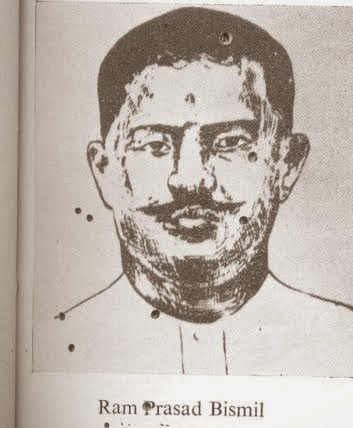
Remembering Ram Prasad Bismil and Ashfaqullah on martyrdom day-19th December through Bhagat Singh


 Politics of Religion/Communalism and ‘The Last Message of Martyr of the Nation Sh. Ram Prasad Bismil’
                                                  Chaman Lal
        
           Bhagat Singh was not only an atheist and socialist revolutionary, he was dead against communalism and wrote essays like-‘Religion wise riots and their Solution’, ‘Religion and our freedom Struggle’. He was votary of equal rights of Dalits and exhorted them ‘to rise like lions and snatch their rights!! What were Bhagat Singh and other revolutionaries views about religion based communal politics is clear from the fact that even a religious revolutionary Ram Prasad Bismil’s last message to the nation, which was translated in Punjabi by Bhagat Singh with his own note to it in ‘Kirti’-Punjabi journal, is  reproduced below!


               In January 1928 issue of ‘Kirti’, a Punjabi/Urdu journal established by Ghadarite revolutionaries in Amritsar in 1926, Bhagat Singh wrote a piece-‘The Last Message of Martyr of the Nation Sh. Ram Prasad Bismil’. Ram Prasad Bismil, Ashfaq Ulla Khan, Roshan Singh and Rajinder Nath Lahiri were hanged in Gorakhpur, Fyzabad, Allahabad and Gonda jails on 19th and 17thDecember 1927 as Kakori case convicts. Lahiri was executed two days earlier on 17thDecember itself in Gonda, other three were executed on 19th. Memorial to Bismil was built in premises of Gorakhpur jail, Ashafq was buried in his home town Shahajahanpur and his memorial is there, though he was hanged in Fyzabad jail. Faizabad was earlier spelled as Fyzabad. Roshan Singh’s memorial stands now in Allahabad, where he was executed, though that jail no more exists. Lahiri monument is in Gonda, all in U.P. Kakori is a small railway station near Lucknow where on 9th August 1925, a dacoity was conducted by revolutionaries of Hindustan Republican Army (HRA) to loot government treasury, in which eight thousand rupees were looted from Government treasury money. Chandershekhar Azad, leader of this group, as well as of HSRA later, could never be arrested, but many others were arrested. The four martyrs of Kakori case became most popular among Indian people, which were surpassed only by Bhagat Singh and his two other comrades-Rajguru and Sukhdev’s martyrdom later in 1931.Memorial to Kakori case martyrs and other convicts has been erected at that very point, where dacoity took place about two kilometre away from Kakori Railway station, where also a descriptive plaque has been put up. The whole area even today looks to be deep thick forest area. Other convicts with long sentences were Jogesh Chander Chatterjee, who rose to become Member of Parliament later, from 1956 till death in 1969,  Sachindernath Sanyal, his brother Bhupendernath Sanyal, Sachindernath Baxi, Rajkumar Sinha, Vishnu Sharan Dublish, Ramkrishan Khatri, Mukundi Lal, Ramnath Pandey, Manmathnath Gupt, Ramdulare Trivedi, Suresh Chander Bhattacharya, Premkrishan Khanna, Govindcharan Kar etc. Kakori case prisoners observed hunger strikes in jails for long periods and on one occasion in 1930, Bhagat Singh sent a telegram from Lahore jail appealing to call of their hunger strike.
              After the executions of Kakori case convicts in December 1927, Bhagat Singh wrote few pieces in next issue of ‘Kirti’ in January 1928 as a tribute to them-‘Tears of love for Kakori Martyrs’, which was an editorial of the journal; Bhagat Singh was part of editorial team and he wrote ‘The condition of Hangings of Kakori Martyrs.’ Earlier he had written ‘Introduction to Kakori Prisoners’ in May 1927 issue of ‘Kirti’. Later Bhagat Singh also a sent a telegram to imprisoned Kakori convicts other than four martyrs, when they were on hunger strike in 1930, through trial court. He translated this very significant message of Ram Prasad Bismil in Punjabi from Hindi with his approval and comment. Bismil’s message holds much significance today in context of Muzaffarnagar riots and increasing communalization of Indian polity, it is apt tribute to Bhagat Singh also. Later Bhagat Singh himself wrote on the menace of Communalism affecting Indian freedom movement many times in ‘Kirti’.

           ( Bismil’s last message with Bhagat Singh comment is being translated from ‘Kirti’ in English for the first time-Chaman Lal)
     

        He has written an autobiographical sketch, which was published in ‘Swadesh’, paper of Gorakhpur. We are presenting the abridged form of that for readers, so that they should know the last thoughts of the revolutionary.
    He writes on 16th (December, 1927-three days before execution)-(Bhagat Singh)


        “The time of execution is fixed for 6.30 am on 19th December. Nothing to worry, I shall be reborn again and again due to God’s grace and my aim will be to ensure complete freedom for the world. That nature’s gifts should be equally shared by all and no one shall rule others. Everywhere people should have their democratic institutions. I now think it necessary to mention those things also which happened with Kakori prisoners after 6th April 1927 session court judgment. There was an appeal in Avadh Chief Court on 18th July. That was only on behalf of four persons sentenced to death. But police filed counter appeal for enhancing the sentence. Then others also filed appeals, but Sh. Sachinder Nath Sanyal, Sh. Bhupender Nath Sanyal and approver Banwari Lal did not appeal. Pranvesh Chatterjee became approver and withdrew appeal. The death sentence remained unchanged, but ten year sentence of Sh. Jogesh Chatteree, Gobind Charan Kar and Mukandi Lal was enhanced to life imprisonment. Seven year sentence of Sh. Suresh Chander Bhattacharya (Editor of ‘Pratap’-Kanpur after the martyrdom of Ganesh Shankar Vidyarthi) and Sh Vishnu Sharan Dublish was enhanced to ten years. Ramnath Pandey’s sentence was reduced to three years and Pranvesh Chatterjee to four years. Prem Krishan Khanna’s dacoity sentence was reduced to five years. Other appeals were dismissed. Ashfaq’s death sentence remained unchanged and Sachinder Nath Bakshi did not file any appeal.
   Before filing an appeal, I had already sent an application to Governor that ‘I have not taken part in any secret conspiracies nor will I have any links with these.’ This application was mentioned in mercy petition also. But judges did not pay any attention to it. I sent my own arguments from jail to Chief Court, but judges said that it is not the writing of Ram Prasad, but has been written with the help of very competent person. Rather they negatively said that ‘Ram Prasad is a dangerous revolutionary and if released, would do the same activities.’
   After appreciating my intelligence, ability etc. They said that ‘he is a merciless murderer, who can even shoot them with whom he has no enmity’. Anyway, they had the pen, whatever they may write! But the decision of Chief Court shows that we have been sentenced to death due to vengeance only.
   Appeal was dismissed, and then mercy petitions were filed with Governor and Viceroy. Almost all the elected members of U.P. legislative Council made a signed appeal to remission the death sentence of Ram Prasad Bismil, Sh. Rajinder Nath Lahiri, Sh. Ashfaqullah and Sh. Roshan Singh. With my father’s efforts, two big landlords and 250 honorary Magistrates gave a separate application. Assembly and Council of State’s 108 members gave application to Viceroy to change our death sentence. They also said that judge had said that ‘if they repent then sentences would be radically reduced’. There were calls from all sides, but there were our blood seekers on all sides and Viceroy also did not listen to us.
 Pandit Madan Mohan Malviya met Viceroy with many people. Everybody thought that now death sentence would be remitted. But what was to happen. Quietly two days before Dussehra, all jails were sent telegrams that the date of executions has been fixed. When I was told about this telegram by Jail superintendent, I also said ‘now you do your job’, but on his insistence sent a mercy telegram to the emperor. That time idea of filing an appeal in Privy Council also struck. Sh. Mohan Lal Saxena advocate was given wire, when he was told that Viceroy had rejected all the applications, nobody believed. Convincing him, the appeal was filed in Privy Council, result was known, and appeal was dismissed prematurely.
   Now the question will arise that knowing everything beforehand, why I sent apology, mercy petition, appeals after appeals? The only reason seems to me that politics is a game of chess. Government has said forcefully in Assembly about Bengal ordinance prisoners that there is strong evidence against them, which we don’t present in open court for the safety of witnesses, though Dakishneswar bomb and Shobha bazaar conspiracy case were heard in open court. Killing of CID superintendent case was also held in open court and Kakori case also took one and half years. 300 prosecution witnesses were produced, none had any problem, though it was also said that the root of Kakori case is in Bengal only. To expose the chinks in government declarations, I did all these things. I gave apology too, sent appeals also, but what was to happen. The reality is that the oppressor kills also and does not allow even to cry/sigh!
     No revolt was going to take place by our being remaining alive. Till now never such strong appeals were made for revolutionaries in India. But what government has to do with it? It is proud of its power. It has arrogance of its oppression. Sir William Maurice had himself remitted the death sentences of Shahjahanpur and Allahabad riots. And these sentences were remitted when riots were taking place every day. If reducing the sentence would have emboldened others then same thing could be said about communal riots also. But here the issue was different.
  I am not disappointed at this time of giving up my life that ‘this is wasted’. Sacrifices never go waste. May be because of our sighs that the idea of sending royal commission came to the mind of Lord Birkenhead, for whose boycott Hindu- Muslims got together again. God may give some wisdom to them fast and they become united again. I had told advocate Mohan Lal Saxena, after our appeal was dismissed, that at least to commemorate us this time Hindu-Muslim leaders should be united.
   Government had mentioned that Sh. Ashfaqullah Khan is the right hand man of Ram Prasad. If a devotee Muslim like Ashfaq could be right hand man of Arya Samajist like Ram Prasad in revolutionary movement, then why other Hindus and Muslims can’t unite forgetting their petty interests? Ashfaq is first such Muslim, who is being executed in connection with Bengal revolutionary party. God has listened to my prayer. My task is over. I have shown India/Hindustan by getting one Muslim youth for sacrifice that Muslim youth can also sacrifice life for the country even more enthusiastically than Hindu youth and he had passed all the tests. Now no one shall dare say that Muslims should not be trusted. This was first experiment which succeeded.
     Ashfaq! May god give peace to your soul. You have saved the honour of mine and all Muslims and also showed that like in Turkey and Egypt, in India also one can find such Muslim youth.
      Now my only request to countrymen is that if they have even an iota of sorrow at our death, then, with whatever means, they must establish Hindu-Muslim unity; that was our last wish and this only can be our memorial.All religions and all parties should consider Congress as a representative. Then the day is not far, when Britishers have to bow before Indians.
 Whatever I am saying, same is the opinion of Sh. Ashfaq Ulla Khan Warsi. At the time of making appeal, I had talked to him in Lucknow; Ashfaq was not agreeable for giving mercy petition. Only on my insistence, he had done so.
        I had even told the government that till it is not ready to trust me, it can keep me in jail or exile to some other country and not allow returning to India. But what government was to do. Government only wanted to hang us, to sprinkle salt on Indians/Hindustanis raw wounds, to make them writhe in pain. Some things may get balanced and by the time we are reborn and get ready to work, the condition of country should have improved.
     Now my advice is that neither one should give any statement before British courts nor make any defence. One reason for making appeal was to get the execution date postponed and see the strength of youth and countrymen’s help! I was really disappointed in this. I had thought of breaking the jail, if it had happened, other three’s death sentence would also had been remitted. If government had not done it, I would have got it done. I knew its methods very well. I tried my best to come out/break jail, but got no help from outside. No youth turned up to help me. My request to youth is that till many people get educated; don’t pay attention to secret organisations. If they have desire to serve the country, they should work openly. Just listening to empty rhetoric and imagining green Pasteur’s, they should not put their lives in trouble. There is yet no time for secret work. We had lot of experiences during this trial, but government did not give us any opportunity to avail these. But for this both Indian and Britain’s English governments will regret.

Tuesday, 1 October 2013

Lokmat Samachar Nagpur report on Bhagat Singh day function in Nagpur-28-9-13

Nagpur Bhagat Singh function report-The Hitavada

Bhagat Singh birth anniversary celebrated in Pakistan

http://economictimes.indiatimes.com/news/politics-and-nation/bhagat-singhs-birth-anniversary-celebrated-in-pakistan/articleshow/23267867.cms?intenttarget=no


On September the 28th 1907, a boy was born in a village near Lyallpur (now Faisalabad). He would grow up to inspire the subcontinent’s youth to fight for independence from the British. The irony is that a great part of his struggle was spent in what is now Pakistan, but after partition Pakistan overlooked his legacy. This young man is Lyallpur’s forgotten hero: Bhagat Singh Shaheed.
In the midst of Ramadan, I visited Singh’s birthplace, Bangay. It is located in the outskirts of Faisalabad city. Mohammad Iqbal Virk, the man whose father was allotted Bhagat Singh’s house and lands after migrating from India to Pakistan, showed me around the property.
Virk is well-versed in the life of Bhagat Singh and has kept many books, articles and photographs of the freedom fighter. His eyes lit up as he talked of the young Shaheed, going down the road of history. At the time of his death, Bhagat Singh was only 23 years old. He was born into a well-known family that had resisted British imperialism for generations. Thus it was hardly a surprise that Bhagat Singh became a freedom fighter.
In December 1928, Bhagat Singh and his colleagues had shot dead assistant superintendent of police, John Saunders, mistaking him for superintendent of police, J.A Scott.
The previous year, nationalist Lala Lajpat Rai had suffered fatal blows at the hands of Scott and the young men wanted to avenge his death. The assassins managed to successfully escape from Lahore. Then in April 1929, Bhagat Singh and a colleague hurled low-intensity bombs into the central legislative assembly before voluntarily surrendering to the police.
The British government accused Bhagat Singh of murdering Saunders. Whilst in jail, Bhagat Singh went on a hunger strike protesting against the unequal treatment of Indian and British prisoners. He lost much weight and was disabled from taking part in his trial.
A government-proposed amendment in the law would have allowed the courts to continue the trial in the absence of Bhagat Singh. Opposing the law, and defending Singh, Muhammad Ali Jinnah said: “The man who goes on hunger strike has a soul. He is moved by that soul and he believes in the justice of his cause; he is not an ordinary criminal who is guilty of cold-blooded, sordid, wicked crime.”
After failing to make the amendment in the law that day, the governor-general resorted to issuing an ordinance that would allow a tribunal to hold what would, in effect, be a sham trial.
Various historians have said the trial lacked impartiality and objectivity. Singh and his compatriots, Sukhdev and Rajguru, were hanged in the gallows of the Lahore Jail on the 23rd of March 1931. Their ashes were cremated at the Sutlej River.
Virk said he has tried to preserve Singh’s belongings to the best of his abilities. Yet, he regrettably admits, that much has been lost due to neglect and ignorance. Pair of wooden doors that lead to the courtyard in Virk’s house in Bangay were installed when Bhagat Singh lived here.
According to Virk, Bhagat Singh planted the sprawling tree in the courtyard. Next to the tree, the Shaheed’s name is inscribed on a blackboard with white paint.
Virk says Sikhs, usually from Canada, come to visit every year and take a bit of the soil from the tree with them. Virk has also kept a bulky, and rather perky blue, safe that he says was Bhagat Singh’s own.
When the Virk family first moved into the house, the women had torn pages out of Singh’s personal book collection to utilize as fuel to cook food, not aware of the historical value of what they were burning. A little far-removed from the house, down a spiraling narrow mud path, are the lush green fields that were used for agricultural purposes by the Singh family.
Now members of the Virk family looks after these lands and Muhammad Iqbal Virk prides himself on the chemical-free ‘pure’ crops he grows on Singh’s old lands.
Bhagat Singh attended the government primary school in the village. One of the classrooms, or rather the ruins of it, is said to have been Bhagat Singh’s classroom at the school. It has only three walls standing and no roof. One of the school’s grounds has disappeared and in its place now is a pool of stagnant rainwater, breeding the dreaded mosquito. Donkeys and cows graze the other ground – the one that isn’t flooded. It is tragically ironic that the school of such a well-read revolutionary has now been left to rot, with no one aware of either its existence or the need for its upkeep. Virk asked me to request the government, through my article, to look after the school.
The role that Bhagat Singh has been assigned in Pakistan’s historical narrative is very similar to the state of public schools in the country. We do not study him in schools and he has been conveniently left out of our textbooks, as if he is a mere irrelevance – an irritant in our pious Islamic Republic’s history of benevolent Muslim freedom fighters.
The result is political leaders, engineered by the same education system, who fail to see the crucial role played by Singh in the movement for independence. The rare public representatives, who do realise his role, brush it under the rug, fearing outrage from the Islamic parties if they try to glorify a hero that wasn’t a Muslim. Bhagat Singh’s house is virtually unknown to the citizens of Faisalabad, let alone the rest of Pakistan.
The government needs to preserve the history that hasn’t yet perished from Bangay. Not only is Bhagat Singh deserving of importance but also he can be a much-needed symbol for national unity that cuts across all differences of caste, class and religion. It is time for Lyallpur to remember her forgotten son.

Inqlab Zindabad=Mainstream-28th September 2013

http://www.mainstreamweekly.net/article4473.html

MAINSTREAM, VOL LI, NO 41, SEPTEMBER 28, 2013

Inquilab Zindabad!

September 28, 2013 marks the immortal revolutionary martyr Bhagat Singh’s 106th birth anniversary. On this occasion we are publishing the following article written and sent for publication around March 23 this year to observe the eightysecond anniversary of Bhagat Singh’s martyrdom. It could not be published then for unavoidable reasons.
It is March 23 now on the clock, the most significant day for the revolutionary movement of not only India, but the whole of South Asia, at least as important for Pakistan as for India. The greatest martyr of both India and Pakistan held the head of dignity of the Indian nation of 1931 and revolutionary movement of the whole world high, with the resounding sounds of ‘Inquilab Zindabad!’ and ‘Down with Imperialism’. The event made British colonialism hang its head in shame before the brave three—Bhagat Singh, Rajguru and Sukhdev!
I am trying to imagine the three days of March 1931. On March 20, Bhagat Singh wrote to the Governor of Punjab, daring him to send a firing squad in order to shoot them, as they were ‘war prisoners’, since a war was on between the Indian nation and British colonialism. On March 22, Bhagat Singh wrote a letter to his comrades, exhorting them to continue the struggle, though they would face immense hardships; more than dying, living and struggling will be more difficult... And on the 23rd itself, I presume, all the three slept well at night, after singing revolutionary songs. They knew March 24 would be the day of their execution.
At the time of meeting, Pran Nath Mehta, their friend and advocate, brought the book on or by Lenin as sought by Bhagat Singh, a day earlier. In all likelihood Pran Nath Mehta must have informed Bhagat Singh, Rajguru and Sukhdev that their families refused to avail themselves of the last meeting with them, though all the three families were present in Lahore that day for the last meeting. Rajguru’s poor mother travelled all the way from Maharashtra to be with her son. Sukhdev’s mother was there with Sukhdev’s uncle, Lala Achint Ram Thapar, who was like a father to Sukhdev after the death of his father earlier. The jail authorities refused permission to Lala Achint Ram to accompany them for the last meeting, because of ‘not being a blood relation’. To protest against this, all the three families refused to meet the three prisoners.
I was trying to gauge the pain of the three mothers, particularly of Rajguru’s poor mother, who came all the way from a village near Pune in Maharashtra, and had not got many chances to meet her son during the trial, being far away. At least Bhagat Singh and Sukhdev’s families had many chances to meet them, being in Punjab. Bhagat Singh was worried that at the last meeting his mother might cry, so he advised her not to come; however, she did come, but now showing exemplary courage bearing pain, all of them refused to see their sons for the last time, exposing the British colonial regime’s cruelty in its worst form.
Bhagat Singh could understood everything. When Bogha, the Dalit jail worker, came, Bhagat Singh asked him to cook lunch for them. In 1931, Bogha cried, he could not commit this ‘sin’ to cook for a ‘high caste’, but Bhagat Singh told him that before going to the gallows, he had to eat from the hands of ‘bebe’, they used to call Bogha, bebe (mother), since like the mother he cleansed their toilets. Bhagat Singh had his way and got his last food from ‘bebe’. Then he started reading Lenin and around four, the jail warder, Chatar Singh, requested them to have a bath, could not explain anything except crying. Bhagat Singh understood that the ‘time was up’, they got ready for the ‘last and final journey’. Bhagat Singh again continued reading Lenin’s book. When around six the jail staff came to fetch them, Bhagat Singh smiled and said: ‘Wait for a while, let me finish this page, a revolutionary is meeting another revolutionary, don’t spoil the beauty of their meeting.’ They waited!
All three, arm-in-arm and singing, started moving towards the gallows. Bhagat Singh’s weight increased by ten pounds, with the expectation of execution (mind ‘expectation’ and not ‘apprehension’), as he was so happy and excited to sacrifice his life for the country and its people, in order to awaken them. I sometimes wonder whether we shall celebrate March 23 with happiness or express sorrow as many people do. Bhagat Singh would have said: ‘Celebrate your struggles on this day, don’t spread gloom, be cheerful and strong!’
At 7 pm or around that time they were at the gallows. Bhagat Singh refused to wear the black cloth on his face and told the British officer: ‘You are lucky to see how happily Indians go to the gallows for the nation.’
Saddam Hussein was not the first to go to the gallows with uncovered face; Bhagat Singh was the first one to do so.
And what did the British do after the executions were over? Scared of the anger of the people gathered at the jail gate, and the news spread fast, they mutilated the bodies by cutting them into pieces, put those into sacks, took those from the back gate towards Hussainiwala, and burnt the bodies with kerosene oil with some Pandit/Granthi around from Kasur. A large number of people walking by foot collected the half-burnt body-pieces, brought those to Lahore and a lakh of people joined the funeral march to the banks of the Ravi in Lahore on March 24 evening. Thus ended the saga of one of the bravest men and patriots of history at the age of 23 years and five months plus, whose slogan ‘Inquilab Zindabad!’ became the war-cry of the freedom struggle after their martyrdom.
‘Inquilab Zindabad!’ II—Long Live Revolution!
Writing ‘Inquilab Zindabad!’ on March 23, I wrote that I would write part two of it. So now I am trying to jot it down. I wish to share here what brought me close to Bhagat Singh in my life.
After passing the Matriculation in my home town Rampura Phul with rather low marks, I was almost lost in the wilderness. There was no college in those days in the town and my father was not in a position to support my college education in nearby towns, Bhatinda or Barnala, at an equal distance of 30 kilometres on opposite sides, where the colleges were located.
My father, a petty trader, always under some debt, did not join as a school teacher, being middle pass in his days, due to ‘little pay’, and had no such sensitivity to educate his children by all means. Under the circumstances, the Public Library of Rampura Phul took me out of my pensive state by opening a whole new world of literary creativity before me. It started with Munshi Prem Chand’s Godan, and I could never settle for a lower level of literary creation. That’s why Punjabi novels did not attract me as much as Hindi ones and translations of Indian and world classics in Hindi. After a while, I became a member of the Hind Pocket Books, Delhi’s scheme of ‘Readers Club’, getting nine rupees worth books for eight rupees, with free postage. And one book for one rupee by Manmath Nath Gupta, Bharat Ke Krantikari having 16 sketches, including that of Bhagat Singh; this was my first encounter with the revolutionary freedom fighters. Manmath Nath Gupta was himself a part of the Kakori Conspiracy Case and got life conviction though being just 15 years or so at that time. I was so impressed that I started translating the book into my mother-tongue, Punjabi. By that time I had done the JBT, teachers training course, and passed Prabhakar (Honours in Hindi) examination as a private candidate, securing the first position in Punjab. This got me a job as a Hindi teacher in a Government High School in Poohla village of Bhatinda district.
These sketches were serialised in Desh Bhagat Yaadan, the fortnightly brought out by the legendary Ghadarite, Baba Gurmukh Singh Lalton, from Desh Bhagat Yadgar Hall, Jalandhar. Some of the pieces were published also in Preetlari, and Aarsee, respected literary journals.
Till that time I could read and understand books in Hindi and Punjabi only, English was a distant dream yet. So I read many books in these languages on the revolutionary heroes and got particularly enchanted with Bhagat Singh. Perhaps the first meeting on Bhagat Singh I attended was on March 23, 1969 in the Public Library, Bhatinda on his martyrdom day, which was addressed by the well-known Punjabi short-story writer and joint editor of Preetlari, Navtej Singh, with his father Gurbux Singh Preetlari at that time.
But I had to struggle a lot, while doing a job, passed graduation privately and even MA
Part-I privately. I joined Panjab University, Chandigarh to complete MA Part-II in Hindi. This opened a new path of life for me. Though I continued with my school job even after completing my MA, my teachers’ union activity and doing MA, Punjabi, again privately, kept me close to study about revolutionaries as well as a lot of creative Indian and world literature. Though I registered for Ph.D in Hindi with Prof Romesh Kuntal Megh, I could not proceed much. In this period, I became quite active in the Punjabi cultural movement and with some writings and translations to my credit, became known as Chaman Lal ‘Prabhakar’ in literary circles. Kumar Vikal, Mohan Bhandari and Bhushan, known as Dhianpuri at that time, and myself became part of a circle and by organising the Punjabi Sahit Sabha at Rampura Phul came in contact with the stalwarts of Punjabi literature as well, that is, Prof Mohan Singh, Sant Singh Sekhon, Gurdial Singh, etc. Paash, Waryam Sandhu, Surinder Hemjyoti, Ajmer Aulakh, Amarjit Chandan, Harbhajan Halwarvi, Attarjeet, Sant Ram Udasi, Lal Singh Dil, etc. were all part of the same stream at that time.
We worked together in the Panjabi Sahit Sabhiachar Manch, with guidance from the Nagi Reddy group of the ML movement in Punjab at that time. During the 1975 Emergency, I spent seven months in Bhatinda and Patiala jails.
In 1977, I joined the JNU for research and left the school job. Five years in the JNU as a student have been the best period of my life so far. After doing a Hindi officer’s job for sometime in Bombay, I had a short stint in journalism as a sub-editor in the Jansatta Hindi daily brought out by Prabhash Joshi, before getting a long-term job at Punjabi University, Patiala as an academic. Before leaving for Patiala, I completed editing Bhagat Singh aur Unke Sathiyon ke Dastavez with Jagmohan Singh for Rajkamal Publishers, Delhi, which got published in 1986, to become an all-time best-seller till now. From 1985 to 2002, I remained confined to literature and have many publications in Hindi, Punjabi and English, books as well as articles in journals/ newspapers.
Again after 2002, my interest returned to Bhagat Singh and this time I collected documents of Bhagat Singh alone with the title, Bhagat Singh ke Sampuran Dastavez (Complete Documents of Bhagat Singh).
The preface of the book was written by Kultar Singh, the younger brother of Bhagat Singh, and the book was released during the World Book Fair in Delhi in February 2004. This also became as much a hit as was the early collection. In the meantime, National Book Trust Chairman Prof Bipan Chandra asked me to write a monograph on Kartar Singh Sarabha, which I completed only after joining the JNU as a Professor in Hindi Translation in 2005. By this time, I got the Central Hindi Directorate award for translating Surjit Patar’s poetry in Hindi, Sahitya Akademi Translation Prize for translating Paash’s poetry in Hindi in 2002 and the Punjab Government’s Shiromani Hindi Sahitkar award in 2003.
By the time I joined the JNU, I had enough publications on Hindi and Punjabi literature, including those of criticism and translation, which were getting published every year. However, from 2006, my whole interest seemed to be concentrated on Bhagat Singh and other revolutionary heroes during the 75th martyr-dom anniversary (2006) and the 2007 birth centenary of Bhagat Singh. I became an active campaigner and writer on Bhagat Singh in this period, more at the non-official level, but some at the official level also. By impressing upon the Left parliamentary parties, which were suppor-ting the UPA Government in those days, I got the Bhagat Singh centenary included in official functions also, and this resulted in publication of Bhagat Singh’s documents from the Publications Division for the first time in 60 years. This was edited by me as Shaheed Bhagat Singh: Dastavezon ke Aaine Mein. Also I got Jail Notebook and Other Writings, with my introduction, published from Leftword, Delhi, which has got many reprints in paperback till now. The NBT also got Bhagat Singh ke Rajnitik Dastavez edited by me. On my own I prepared a book in Punjabi, my mother-tongue, Bhagat Singh: Vicharvan Inquilabi, published by Navyug Press, Delhi, the best in a Punjabi language publication. My own writings in Hindi on Bhagat Singh were published in 2009 under the title, Bhagat Singh, by Medha Books, Delhi. Another collection of my writings on Bhagat Singh, including some in EPW and Monthly Review, is now being published as Understanding Bhagat Singh from Aakar Books, Delhi. The Hindi literary monthly Gyanoudey also got a column on Indian revolutionaries from me during 2007, which is now ready to be published in book form any time. In Punjabi my book appeared as Inquilabi Itihas De Sunehari Panne in 2006, by Tarak Bharti Publishers, Barnala. During 2006-2010, I delivered fifty plus lectures on Bhagat Singh in different parts of the country and abroad. My NBT collection of Bhagat Singh’s documents has recently come out in Urdu translation also, which I hope reaches Pakistan. The Publications Division’s large collection of documents has also been translated in Urdu and is likely to be published soon.
Why did I get so involved with this theme? As part of the Left and democratic movement, I realised that one needs to have heroes from one’s own tradition to have emotional appeal among the masses. Bhagat Singh is one such hero, who has mass appeal, and who had the best enlightened Leftist ideas during the freedom movement. Bhagat Singh, like Che Guevara, is an ideal hero for not only India, but South Asia as a whole, as Che Guevara is for the whole of Latin America and both together for the whole world. The other reason was to place Bhagat Singh in the proper ideological perspective. He was just projected as a brave, fearless patriot, but despite his writings being available, he was not projected as a clear socialist revolutionary thinker, to some extent deliberately. Prof Bipan Chandra brought out his ideological position clearly in the 1970s. I took it further by bringing into light his writings in focus, so that the people could know him directly from his writings.
I have more material to focus on him, like the official documents from the National Archives including intelligence reports, which I want to use in a book, Bhagat Singh: Through Colonial and Nationalist Perspectives. I have a desire to get a complete set of articles published in the Mainstream journal in book form as Bhagat Singh in Mainstream which could prove to be the best collection of articles on Bhagat Singh. I am working now on my magnum opus, Bhagat Singh Reader, assigned to me by Penguin India for the international edition. It may be completed this year. This will present Bhagat Singh’s complete documents in English at the international level. And this will provide me with the greatest satisfaction of my life, as and when it comes out.

Saturday, 24 August 2013

How much Free we Are?-PTC discussion on 15th August

dISCUSSION ON THE EVE OF iNDEPENDENCE DAY ON PTC NEWS CHANNEL

http://www.youtube.com/watch?v=pxl4mdkeKBE&feature=youtu.be-
 http://www.youtube.com/watch?v=XmMab9H6OmI&feature=youtu.be

PTC News Discussion on Bhagat Singh with Bhagat Singh nephews

http://www.youtube.com/watch?v=NRXpXvY13HM&feature=youtu.be 03- http://www.youtube.com/watch?v=EWV9yfNyazg&feature=youtu.behttp://www.youtube.com/watch?v=NMoW0_Dv3NU&feature=youtu.be http://www.youtube.com/watch?v=NRXpXvY13HM&feature=youtu.be- http://www.youtube.com/watch?v=1mb664RyJ3g&feature=youtu.be http://www.youtube.com/watch?v=CsbEDxZCPmw&feature=youtu.be

Thursday, 15 August 2013

Gandhi VS. Bhagat Singh and other revolutionaries-serious debate-Philosophy of the Bomb

https://www.facebook.com/notes/chaman-lal-jnu/gandhi-vs-bhagat-singh-and-other-revolutionaries-serious-debate-philo
Philosophy of the Bomb. (Hindi)

[In the national struggle for freedom, Gandhiji was always one step ahead of the British government in criticizing the revolutionaries. On the 23rd of December, 1929 the revolutionaries tried to blow up the train of the pillar of British imperialism, the Viceroy; an attempt that failed. Gandhiji wrote a pungent essay ‘Bomb ki Pooja’ (‘Cult of the Bomb’) on this incident in which he referred to the Viceroy as a well-wisher of the country and the youth as the obstacle in the path of freedom. In response to this, Bhagwati Charan Vohra wrote an essay ‘The Philosophy of the Bomb’ Bhagat Singh gave finishing touches to the essay in jail. On the 26th of January 1930, it was distributed all over the country – Editor] According to Virender Sandhu, niece of Bhagat Singh and first compiler of Bhagat Singh’s documents, this document was sent from jail, as per Jitendernath Sanyal, first biographer of Bhagat Singh, who was sentenced to two years imprisonment for writing this biography. However according to Shiv Verma, this was drafted by Bhagwati Charan Vohra and Bhagat Singh’s another family member thinks that it was finalized by Bhagat Singh in jail.

Just consider recent events. Especially, the attempt made to blow up the special train of the Viceroy on the 23rd of December, 1929, the resolution passed by the Congress to criticize the incident, and the essays written by Gandhi ji in Young India make it clear that the Indian Congress are in perfect accord with Gandhi ji and have launched a dreadful agitation against Indian revolutionaries. A constant propaganda is being carried out against the revolutionaries through public speeches and pamphlets. It has been done either deliberately or through ignorance, but misinformation is being spread against the revolutionaries and they have been misunderstood. But revolutionaries are not afraid of criticism of their principles or their activities. They rather welcome criticism as they consider it a golden opportunity to explain to the people the basic principles and noble ideals that are an inspiration and continuous source of strength for them. It is hoped that this essay will help the world to become aware of what the revolutionaries are, and they will be rescued from the canards spread about them.

Let us begin by considering the question of violence and non-violence. In our opinion, these words have been used wrongly, and this is an injustice to the cause of both the parties, because these words do not help elucidate the principles of either of the two parties. Violence means the use of force for injustice but that is not the aim of the revolutionaries, and on the other hand, the commonly understood meaning of non-violence is the principle of spiritual strength. It is used to achieve individual and national rights. It is hoped that causing pain to oneself will cause a change of heart in the adversary.

When a revolutionary accepts certain things as his right, then he demands them; he offers arguments in favour of his demands, aspires to win them with all the energy of spiritual force, endures great agony to procure them; he is present to make the highest sacrifice for them and he uses all his physical energy in its support. You may choose to call his efforts by whatever name you please but you cannot refer to them as violence, because by doing so, you are violating the dictionary meaning given to it. Satyagraha means to ‘aagraah’ that is, plead for ‘satya’ that is, truth. Why call only for spiritual force for its acceptance? Why should physical force not be used for it as well? The revolutionaries believe in the use of both their physical and moral force in attaining liberation, but those who use moral force think that physical force is forbidden. So the question is not whether you want violence or non-violence but whether you are willing to use both physical and moral force or moral force alone, to attain your goal.

The revolutionaries believe that the country can get liberation only through a revolution. The revolution that they are trying for and its form that is manifest before them does not merely mean that there should be an armed struggle between the foreign rulers and their compradors on one side and the revolutionaries on the other; but along with the armed struggle, the doors of a new social structure should be freed for the nation. The revolution will put an end to capitalism, class system and the system that gives greater rights to only a select few. It will enable the nation to stand on her feet and this will lead to a birth of a new nation and a new socieity. The most important thing the revolution will do is that it will establish a rule of the working and the peasant class and finish all socially undesirable elements that have seized the political power in the country.

The revolutionary sees the sprouting of the seed of progressiveness in the nascent generation of today that is shackled by mental slavery and religious obscurantism and in the eagerness of this nascent society to break free of these shackles. As the youth begins to understand his own psychology, the picture of the slavery of the nation will become clearer to him and his desire to free his country will grow stronger. And this chain will continue till the youth becomes a blend of justice, anger and anguish and begins to kill those who perpetrate injustice. In this manner, terrorism will be born in the country. Terrorism is not complete revolution, and even revolution is incomplete without terrorism. It is a vital limb of revolution. An analysis of any revolution that has taken place in history will prove this principle. Terrorism strikes terror in the heart of the oppressor and gives strength to the oppressed people to react. Those who are of unstable) emotions derive strength from it and it builds self-confidence in them. This leads to the true aim of revolution to come before the world, because this is evidence that makes one believe in a keen aspiration for the liberation of the country. As it has been happening in other countries, similarly in India, terrorism will acquire the form of revolution and finally it is revolution that will bring social, political and economic liberation to the country.

So this is the  ideology of a revolutionary in which he believes and which he wants to attain for his country. To attain this truth he uses both open and covert underground methods. In this manner, the experience of the tussle struggle between the ruler and the people that has been going on for a century in this world, is a beacon to show the path in order to reach that goal. The methods that the revolutionary believes in, have never failed.

What was the Congress doing in the meantime? They have declared a change in their goal from ‘Swarajya’/Self Rule) to ‘Poorna Swatantra’ ‘Complete Freedom’. This declaration will lead anyone to conclude that the Congress has not declared a war against British rule but against the revolutionaries. In this context, the first blow dealt by the Congress was the resolution, in which they denounced the attempt to blow up the special train of the Viceroy on the 23rd of December, 1929. And it was Gandhi ji who prepared the draft of the proposal and bent all his energy into getting the resolution passed. The result was that it could be passed with a majority of only 31 votes in a total strength of 1913 members. Was there any political integrity in this wafer thin majority? In this context, we only present Chaudhrani Sarla Devi’s views. She was a lifelong devotee of Congress. Answering a question related to this issue she said, “I’ve learnt from the talk that I’ve had with Mahatma Gandhi’s followers that they were unable to express their thoughts independently due to their devotion to Mahatma Gandhi and were unable to give their vote to oppose the resolution that Mahatma ji had formulated. As far as the argument of Gandhiji is concerned, we shall discuss it later. Whatever arguments he has put forward are, by and large, an expanded form of the speeches given in the Congress.

In the matter of this unfortunate resolution, there is one important factor that we cannot ignore, that it is self-evident that the Congress abides by the principle of non-violence and has propagated for it for the past ten years. Despite all this, bitter words were exchanged during the speeches made in support of the resolution. They called the revolutionaries cowards and their activities hateful. One of the gentlemen even went to the extent of issuing a threat, saying that if they wanted Gandhi ji to lead them, then they would have to pass the resolution unanimously. Despite all these efforts, the resolution could be passed with only a few votes. This proves without doubt that the people of the country supported the revolutionaries in sufficient numbers. In a way Gandhi ji deserves our congratulations for turning the spotlight on this topic, and in this manner showing the world that the Congress, considered to be a fortress of non-violence is, if not completely, partially at least, with the revolutionaries rather than with the Congress.

The victory that Gandhi ji won in this regard was a failure in a way and now with ‘The Cult of the Bomb’ he made another attack on the revolutionaries. Before saying anything further about this, let us reflect upon this essay. He has highlighted three things in this essay – his faith, his ideas and his point of view. We shall not analyze his faith because there is no place for reason in a matter of faith. However, we shall analyze point by point what Gandhi ji refers to as violence, and against which he has presented his arguments.

Gandhi ji thinks that his assumption that the emotion of violence has not touched a majority of the Indians and non-violence has become their political weapon is a correct one. His travel around the country recently has led him to come to believe this, but the experience of his journey should not let him fall under this illusion. This is certainly true that the (Congress) leader keeps his visit limited to where the mail train can take him comfortably, whereas Gandhi ji has extended the radius of his visit till where the motor car can take him. During this journey he  resided at the residences of rich people only. Most of the time during this journey was spent in listening to his own praises being sung in meetings organized by his devotees,  occasionally bestowing an audience to the illiterate masses in meetings whom he claims to understand very well, but this very thing goes contrary to his argument that he is familiar with the thoughts of the common people.

No person can understand the thoughts of the common people only by appearing on stages and preaching. He can only claim that he has presented his views on a variety of topics before those people. Did Gandhi ji, in all these years, ever try to enter the social life of the common public? Did he ever, at sundown ever sit in front of a community  place(chaupal/sathh) in the heart of any village to listen to the thoughts of a peasant? Did he ever spend an evening with a worker working in a factory to understand his views? But we have done so and we can claim that we know the common people. We assure Gandhi ji that the ordinary Indian, like an ordinary person, does not really understand the spiritual emotion of non-violence and the precept of ‘love thy enemy’. This is the law of nature – you have a friend, you love your friend, sometimes so much that you even give up your life for your friend. You have an enemy; you don’t keep any kind of relationship with him. This principle of the revolutionaries is totally true, simple and straightforward, and this eternal truth has come from the time of Adam and Eve and no one has ever had a difficulty in understanding this. We are saying this from our own personal experience. That day is not far when people will gather in thousands to give a concrete shape to the revolutionary ideology.

Gandhi ji declares that through ahimsa or non-violence and torturing one’s own self, he hopes to one day change the heart of the foreign rulers and convert them to his way of thinking. Now he has dedicated his life to this magical social message of love. He propagates this with unfailing faith, just as some of his devotees have done. But can they tell us how many of India’s enemies have they been able to convert to friends of India? How many O’Dwyers, Dyers, and Reading and Irwin have been converted into friends of India? If not even one of them, then how can India accept this ideology that he would be able to convince England through ahimsa non violence to grant freedom to India?

If the bombs had exploded in the proper manner under the train of the Viceroy, then one of the following two things would have definitely happened – either the Viceroy would have been grievously wounded, or died. In such a situation, the meeting between the Viceroy and the leaders of the political parties would not have taken place, this attempt would have come to naught, and this would only have benefited the nation. The contemptible attempts of the leaders hovering around the Viceregal House to beg for Home Rule even after the challenge in the Calcutta Congress would have failed. If the bombs had exploded properly, then one enemy of India would have been given just punishement. Those who filed the Meerut and Lahore Conspiracy Cases, and of the Bhusawal Conspiracy/Case, can appear in a friendly light only to the enemies of India. Irwin succeeded in destroying the united opposition in the entire nation against the Simon Commission only after the political sagacity of Gandhi and Nehru. Today Congress is internally divided. Who but the Viceroy or his sycophants/ are responsible for our misfortune? Despite this, there are people in our country who think of them as India’s friends.

There would also be people in this country who have no allegiance to the Congress or have no hopes from the Congress. If Gandhi ji counts the revolutionaries amongst this group, then he does them an injustice. They are well aware that the Congress has done significant work in creating awareness among the people. It has given rise to a desire for freedom in the common people, but it is their firm belief till there are people of ‘extraordinary’ calibre like Sen Gupta in the Congress, who talks of the hand of the secret service/ in the bombing of the Viceroy’s train, and people like Ansari, who don’t have any understanding of politics and use illogical and irrational arguments instead of offering cogent arguments and say that no nation has won freedom through a bomb – till the time such ideas dominate the decisions of the Congress, till then the country can expect very little from it. The revolutionary is lying in wait for a day when this fad of ahimsanon violence will come to an end in the Congress and they will stand shoulder to shoulder with the revolutionaries towards the collective goal of complete freedom. This year the Congress has accepted this principle that the revolutionaries have believed in for the past 25 years. We shall hope that next year they will also support their methods of attaining freedom.

Gandhi ji argues that whenever violence was used, military expenditure went up. If he is pointing towards the activities of the revolutionaries for the last 25 yers, then we challenge his words and de..mand that he back his words with facts with statistics. On the other hand we feel that the consequence of their experiments with ahimsa non violence and satyagraha, which cannot be equated with the freedom struggle, has affected the beaureaucraticeconomy. The consequences of frequent agitations be they violent or non-violent, successful or unsuccessful, will be felt on India’s economy. .

We fail to understand why Gandhi ji unnecessarily involves us in the various constitutional reforms. He never took the least bit of interest in the Morley-Minto Reforms, Montague Reforms, or several other reforms, nor ever agitated for them. It was before the agitators that the British government threw these constitutional crumbs so that they could be misguided from the right path. This was a bribe offered by the British government to them to cooperate with them, to destroy the revolutionaries from roots. Gandhi ji demands for them these, as he refers to them, toys for India, to amuse people who agitate from time to time, Home Rule, Self-Rule, Responsible Governemnt, Full Responsible Government/, Colonial Self-Rule, and other constitutional epithets, that are all slavery. The aim of the revolutionaries is not reform of the government; they raised the level of freedom high long ago, and they are offering sacrifices for this unhesitatingly for the attainment of this goal. They claim that their sacrifices have transformed the thinking of the common masses. With their efforts, they have taken the country far ahead on the path to freedom, and even those who differ from them in the political field, accept this as true.

According to Gandhi ji, violence obstructs the path of progress and postpones the day of attaining freedom, and in response to this we can give several such examples, where nations that used violence became socially progressive and achieved political independence. Let us take the example of Russia and Turkey. Both used violent methods and attained power only through an armed revolution. Even afterwards, due to the social reforms, the people there made rapid progress. Only by the example of Afghanistan, can one not prove a political premise/.That is an exception.

In Gandhi ji’s views, the awareness created among the public during the Non-Cooperation Movement was the result of the message of ahimsa non violence, but this belief is flawed, and to credit ahimsa non violence for it, is a mistake, because wherever there has been a raising of public consciousness, it has been through directaction. For example, it is through powerful public agitation that the peasants and  workers were made aware in Russia. No one had preached ahimsa non violence to them; in fact we will go so far as to say that it is because of ahimsa non violence and Gandhi ji’s policy of compromise that caused those powers to crack that had been united with the slogan of a collective front. This is arguedthat battling political injustice with the weapon of ahimsa non violence is possible, but one can only sum up one’s views on this topic and say that this is a strange idea which hasnever not been put to test yet.

The weapon of ahimsa non violence proved unsuccessful in winning the justifiable rights that Indians in South Africa deserved. It even proved unsuccessful in winning self-rule for India whereas a huge army of National Congress volunteers kept striving for it and more than a crore&quarter rupees was spent on it. In the recent Bardoli Satyagraha the inefficacy of it, has been proved. On this occasion, the leaders of the Satyagraha, Gandhi and Patel were unsuccessful in securing even the minimum rights which they had assured the peasants of achieving. Apart from these, we are not aware of any other national agitation. Till now this ahimsa non violence has won only one blessing and that is of failure. In such a situation it is hardly surprising that the country has refuted their experiment. In fact, the form of Satyagraha that Gandhi ji is promtoing is a kind of agitation, an opposition, for which the natural consequence is compromise, as has been witnessed first hand. So the sooner we understand that there can be no pact  between liberation and slavery, the better it would be.

Gandhi ji believes that we are entering a new age. But in the constitution of the Congress, this is mere word-play, that is, to call Swarajya, ‘complete freedom’ does not start a new age. That will actually be a great day when the Congress will decide to start an all-India agitation, with universally accepted revolutionary ideals as its basis. Till such time it is laughable to hold the banner of freedom. In this issue, we are in agreement with Chaudhrani Sarla Devi’s views that she expressed in an interview with a newspaper correspondent. She said – ‘To unfurl the flag of freedom at one minute past midnight on the night of the 31st of December, 1929 is strange. The G.O.C, Assistant G.O.C, and the other people knew well that the decision to unfurl the flag of freedom hung in the balance till midnight, because if the Viceroy or Secretary of State had sent the message that India had been grantecolonial/ self-rule, then even at 59 minutes past 11 the situation could have changed.” This makes it evident that the goal of attainment of complete freedom was never the heart-felt desire of the leaders, but like the tantrum of a spoilt brat. What would have been appropriate for the Indian National Congress was to have first attained freedom and then to make the announcement. The truth is that now instead of colonial swarajya/, the Congress spokespersons will beat the drum of complete freedom before the public. Now they will tell the people that they should be ready for the struggle, in which one side will offer punches but the other will only just endure them till the time he is so badly beaten that he can no longer get up. Can this be called struggle and can this win the freedom of the country? For any nation it is good to keep the aim of complete attainment of goals, but it is also necessary along with it that to reach this aim, those methods should be used that are able, and those have been used before, otherwise we face the danger of becoming a laughing stock in the eyes of the world.

Gandhi ji has urged all intellectuals to stop supporting the revolutionaries and to criticize their activities so that they can understand the harm that has been caused by the violent actitives of such neglected patriots. How easy it is to insult people and call them votaries of trite arguments, in the same way, to criticize them and tell the public not to support them, so that they are forced to scatter and postpone their activities, all this become easy, to do especially for such a person, who enjoys the confidence of some of the influential people of the public. Gandhi ji all his life interacted with masses, but it is a sad fact that he neither understands the psychology of the revolutionaries, nor wishes to do so. The principle that is dear to the revolutionaries is a priceless one. A person who becomes a revolutionary carries his head on his palm and is ready to lay down his life in an instant and not for fun. He makes a sacrifice and renunciation not to win the sympathy and applause of the public. He follows this path because his conscience encourages him to do so; his soul inspires him for this.

A revolutionary places the maximum belief in reason. He believes in logic and nothing but logic. Any swear words or criticism, even if it comes from the highest source, cannot deflect him from striving for his chosen aim. It is sheer foolishness to believe that he would abandon his goal if the public does not support him or if his work is not appreciated. Several revolutionaries, whose work has come in for heavy criticism from the constitutional agitators, did not care two hoots and went to the gallows. If you want the revolutionaries to postpone their activities, then what should happen is that you should prove the truth of your logic through argument. This is the one and only way, and no one should have any doubt regarding any other thing. Revolutionaries are definitely not going to surrender to threats.

We request every patriot to join us in all seriousness in this war. Let no man use psychological experiments like ahimsa non violence and other such strange methods and play with the freedom of the country. Freedom is the breath of the country. Our slavery is shameful for us, who knows when we will have the wisdom and the courage to rid ourselves of it and become free? Of what use are our ancient civilization and a glorious heritage if we don’t have pride in our own self any more to prevent ourselves from bowing to foreign slavery, a foreign banner and emperor?

Is it not a crime that Britain has imposed an immoral rule over India? Made us beggars and sucked the blood out of us. In the name of one rac and of humanity, they have humiliated and exploited us. Do the people still want us to forget our humiliation and forgive the British rulers? We shall avenge this; and this will be a fitting revenge of the people upon the rulers. Let cowards turn their backs and cling to a policy of appeasement in the hope of peace. We don’t seek mercy in alms from anyone; nor shall we forgive anyone. Our war shall continue till either victory or death. Long live the revolution!

                                                                                    Kartar Singh

                                                                                    President  


sophy-of-th/10151868899133413